Fill Level Inspection: Stopping Underfills at the Source

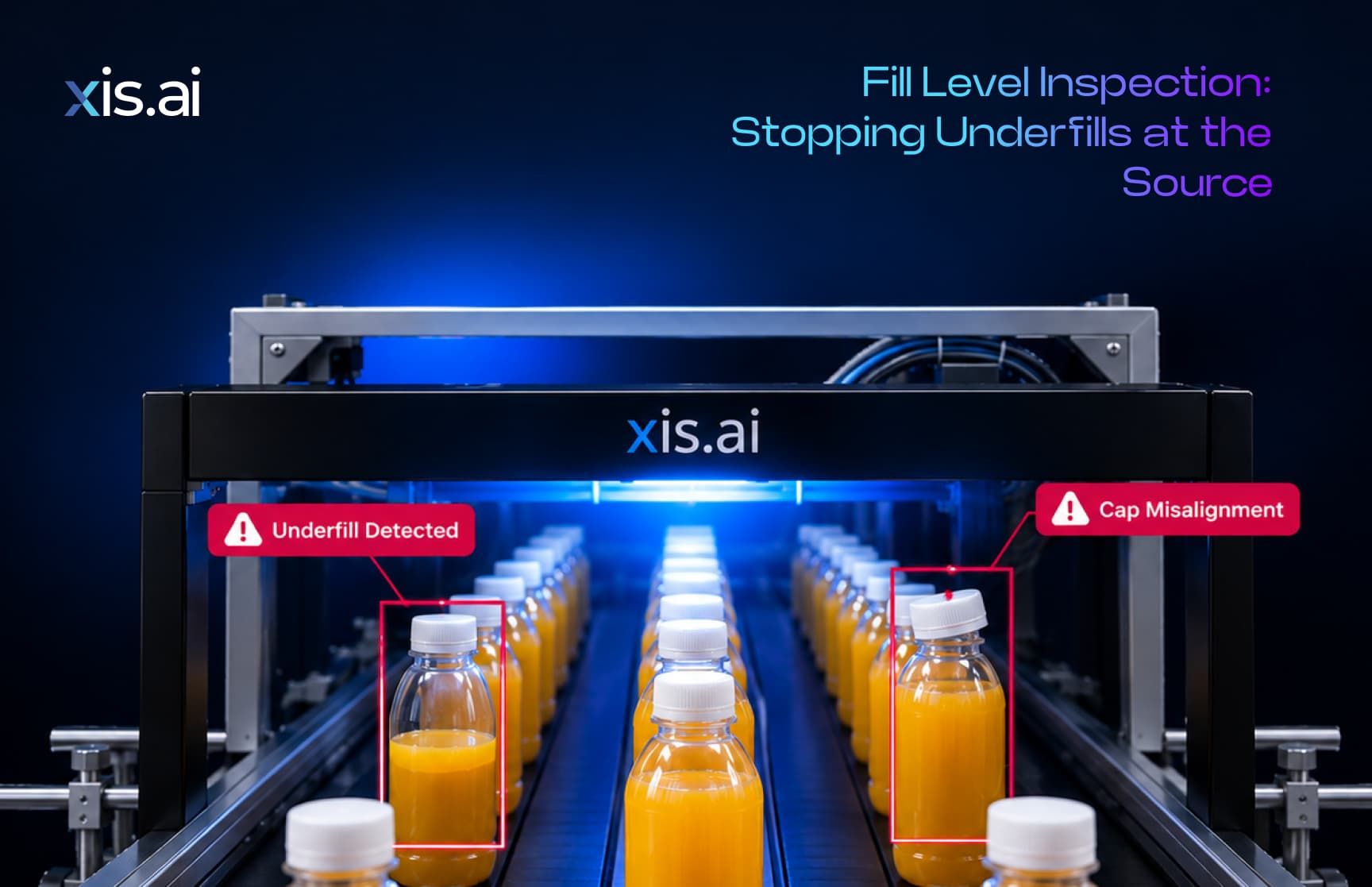
A beverage bottling line fills roughly one container every second. A dairy plant fills tens of thousands of cartons per shift. A pharmaceutical facility fills vials in fractions of a second per unit. Across every one of these production environments, fill level is measured not in a single inspection category but in three very different contexts, each with its own tolerance, its own risk, and its own reason the deviation matters. Fill level inspection with AI is applied differently depending on which of these contexts it operates in and understanding that difference is the fastest way to understand why generic, one-size-fits-all fill checks tend to underperform against purpose-built inspection.
Fill Level Inspection in Beverage Bottling
In beverage production, an underfilled bottle is primarily a consumer trust problem. A customer who receives a visibly short-filled bottle assumes the brand cut corners, and that perception travels faster than any correction a manufacturer can issue after the fact. Overfilling carries a different cost entirely: product waste at scale, since even a small volume overage per bottle compounds into a significant material loss across a high-speed run.
AI-based fill level inspection on a beverage line typically works alongside cap and label verification, since these three checks tend to be evaluated at the same station moving at the same line speed. As covered in Bottle Inspection with AI: Catching Defects Early, surface and structural defects are checked using the same real-time camera infrastructure that fill-level detection relies on, which is why beverage manufacturers generally deploy fill level, cap, and surface checks as one integrated inspection point rather than three separate systems bolted together.
Fill Level Inspection in Dairy and Liquid Food Packaging
Dairy and liquid food products introduce a variable that beverage bottling rarely faces at the same scale: opaque or semi-opaque containers where the liquid boundary is not always visible through the container wall itself. This forces fill level detection to rely on alternative measurement approaches, weight-based verification, fill-height sensors integrated with vision systems, or imaging calibrated specifically to the container's fill window, rather than a straightforward visual boundary check.
The stakes here extend beyond brand perception into regulatory compliance, since packaged food products are typically required to meet declared net-weight or net-volume standards. A dairy carton that consistently underfills by even a small margin can accumulate into a labeling-accuracy violation across a production run, independent of any individual customer complaint. Cap seating and seal integrity often correlate with fill-level accuracy on the same line, a relationship discussed further in Cap Inspection with AI: Catching Missing Caps and Seals, since a fill-level deviation and a seal defect frequently share the same root cause in filling equipment calibration.
Fill Level Inspection in Pharmaceutical Vials and Injectables
Pharmaceutical fill level inspection operates under the tightest tolerance of the three contexts, because in injectable products, fill volume is directly tied to patient dosage. An underfilled vial is not a customer satisfaction issue; it is a clinical one, potentially delivering less active ingredient than a prescribed dose requires. An overfilled vial can carry its own risk depending on the product and delivery method.
This is why pharmaceutical fill level inspection is typically measured against a far narrower tolerance band and validated with additional imaging passes compared to consumer packaging. As detailed in Vial Inspection for Pharma: Seeing Hidden Defects, fill-level detection in this context is evaluated alongside particulate and structural crack detection, since all three checks depend on the same high-precision imaging setup and the same regulatory scrutiny applies to each.
How AI Fill Level Detection Actually Measures Volume
Across all three contexts, AI-based fill level detection follows the same underlying principle even as the specific technique varies: the system identifies the liquid boundary within a calibrated reference frame specific to the container geometry in production, then compares the measured fill height or volume against a target range. Where the container is clear, this is a direct visual measurement. Where the container is opaque, the system substitutes weight sensing or a specialized imaging technique calibrated to the fill window.
What distinguishes AI-based detection from a fixed-rule sensor threshold is adaptability across product changes. A single production line running multiple container sizes or multiple products with different target fill volumes does not require manual recalibration for each changeover; the model adjusts its reference range based on the container and product identification already flowing through the line's tracking system.
The Cost of Getting Fill Level Wrong
Fill level errors carry a cost profile that differs meaningfully from most other packaging defects, because the cost scales with volume rather than with the severity of any single unit. A one-percent systemic underfill across a high-volume beverage line represents a measurable and recurring compliance exposure, not a handful of isolated customer complaints. Overfill, inversely, represents pure material cost with no offsetting benefit, since the extra product delivered generates no additional revenue.
This is part of why fill level inspection tends to deliver a clearer, more immediately visible return than some other inspection categories: the savings from correcting a systemic overfill, or the compliance risk avoided by catching a systemic underfill, show up directly in material cost and audit readiness rather than requiring a longer chain of reasoning to justify the investment. Broader inspection categories that share this cost dynamic are discussed in AI-Powered Food Packaging Inspection: How Vision AI Protects Food Brands from Packaging Failures, which covers how fill-level accuracy contributes to the overall packaging integrity picture alongside seal and cap checks.
Building Fill Level Inspection Into an Existing Line
Adding fill level inspection to an existing production line generally starts with identifying where fill-level variation is currently going undetected, whether that is immediately after filling, before capping, or only surfacing later as a customer or compliance complaint. Cameras or weight sensors are positioned at the point in the line where the measurement will be most accurate for that specific container type, and the system is calibrated against the declared fill target for each product SKU running on that line. Because most production lines run multiple SKUs over time, the calibration step is typically designed to scale across product changeovers rather than requiring a rebuild each time.
Frequently Asked Questions
How does AI fill level inspection work for opaque containers?
For opaque or semi-opaque containers, AI-based systems rely on weight-based verification or fill-height sensors calibrated to the container's fill window, rather than a direct visual boundary measurement.
Why is fill level tolerance tighter in pharmaceutical products than in beverages?
In injectable pharmaceutical products, fill volume is directly tied to patient dosage, making even small deviations a clinical risk rather than a consumer satisfaction issue, which is why pharmaceutical fill level tolerances are measured far more narrowly.
Can fill level inspection handle multiple container sizes on the same line?
Yes. AI-based systems adjust their calibrated reference range based on the container and product identification already tracked on the line, avoiding manual recalibration for each product changeover.
What is the difference between overfill and underfill costs?
Underfilling primarily creates compliance and customer trust risk, since delivered volume falls short of what is declared or required, while overfilling represents direct material waste with no corresponding revenue benefit.
Does fill level inspection need to be a separate system from cap and label inspection?
Not typically. On most production lines, fill level, cap, and label checks are integrated into a single inspection point using shared camera infrastructure, since all three are evaluated at the same production speed and station.
Comment
0Comments
No comments yet.