Vial Inspection for Pharma: Seeing Hidden Defects

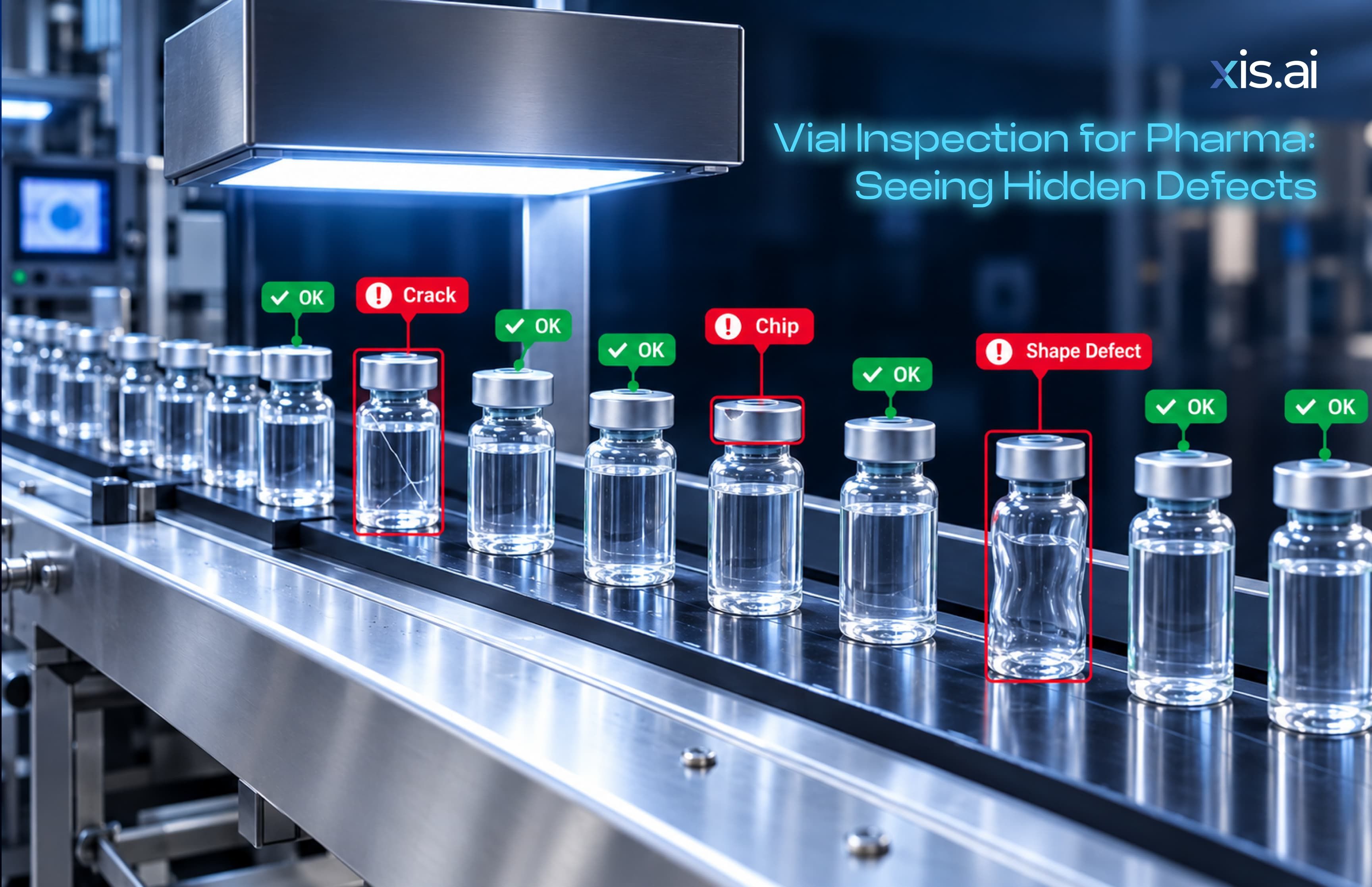
A vial that passes visual inspection can still carry a defect that only becomes dangerous once it reaches a patient: a hairline crack invisible under standard lighting, a glass particulate suspended in the solution, or a fill volume slightly off from the labeled dose. Vial inspection exists precisely because these defects are the kind a quick glance is least equipped to catch, and in injectable pharmaceutical products, the margin for error is measured in patient safety, not just product presentation.
This is the operational problem pharmaceutical manufacturers are working through as injectable production scales: the defect categories that matter most in vials are also the ones traditional inspection methods are worst positioned to detect consistently.
The Problem: Why Vial Defects Are Hard to Catch
Vials present a harder inspection surface than most pharmaceutical packaging. The glass is curved, often clear or lightly tinted, and the defects that matter, hairline cracks, embedded particulates, and fill-level deviations, frequently produce very little visual contrast against the container itself. A crack running along the curvature of a vial can be nearly invisible from a fixed viewing angle and only become apparent under specific lighting or when the vial is rotated.
Manual visual inspection, historically the industry standard for injectable products, depends on trained inspectors examining vials individually or in small batches, often under magnification and specific lighting setups. Even under ideal conditions, inspector fatigue and the inherent difficulty of the visual task itself mean detection rates for subtle defects vary meaningfully between inspectors and across a shift.
Rule-based machine vision systems address consistency but introduce a different limitation. Fixed geometric and pixel-comparison rules perform reliably for defects that match a predefined pattern, and poorly for anything outside that pattern, an important constraint given how varied crack shapes, particulate sizes, and fill-level deviations can be in practice.
Detecting Cracks and Structural Defects
Hairline cracks are among the most dangerous vial defects because they can compromise container closure integrity without being visually obvious. AI-based vial inspection addresses this by capturing images from multiple angles as the vial rotates through the inspection station, allowing the model to evaluate the full circumference rather than relying on a single fixed viewpoint. This mirrors a broader principle in pharmaceutical injectable inspection: as covered in AI Syringe Defect Detection in Pharmaceutical Manufacturing, structural defects such as cracks and fractures in glass or plastic containers require the same multi-angle detection approach to catch damage that would otherwise go unnoticed from a single camera position.
Because the AI model learns the visual range of a structurally sound vial from labeled production data, it identifies deviations that fall outside that trained standard, including crack patterns the system has not been explicitly programmed to recognize as a defect category.
Detecting Particulate Contamination
Foreign particulate matter inside a vial, glass fragments, fibers, or other contaminants, poses a direct patient safety risk in injectable products and is regulated accordingly. Detecting particulates is complicated by the fact that the liquid inside a vial is often in motion during inspection, and particulates can be small, low-contrast, or briefly obscured depending on the angle and lighting at the moment of capture.
AI-based inspection systems address this through high-speed imaging synchronized with the inspection station's rotation or agitation cycle, capturing multiple frames per vial to increase the likelihood of catching a particulate regardless of its position at any single moment. This same imaging principle applies broadly across pharmaceutical packaging inspection, and is discussed in relation to compliance-critical detection more generally in Pharma Manufacturing: AI for Packaging and Label Accuracy, which covers how AI-driven inspection systems are deployed specifically to catch defects that traditional barcode and vision systems struggle to identify reliably in real-world production conditions.
Detecting Fill-Level Deviations
An underfilled or overfilled vial represents a dosing error, which in an injectable product carries direct clinical consequences rather than a cosmetic one. Fill-level inspection requires the system to measure liquid volume precisely against a target range, a task complicated by variation in vial shape, meniscus behavior, and lighting reflections off the liquid surface.
Computer vision-based fill-level detection addresses this by measuring the liquid boundary against calibrated reference points specific to the vial geometry in production, adjusting automatically as different vial sizes or product lines move through the same inspection station. Pattern recognition of this kind, applied to a different but comparable pharmaceutical packaging challenge, is detailed in AI for Pharmaceutical Blister Pack Inspection, which addresses how AI-based systems adapt inspection parameters across varied product formats without requiring a full rule rewrite for each new SKU.
Building a Reliable Vial Inspection Process
Solving the vial inspection problem effectively means treating cracks, particulates, and fill-level defects as three distinct detection challenges rather than a single generic check, since each requires a different imaging approach, capture timing, and model training focus. A deployment scoped around the specific defect categories most relevant to a given production line, rather than a generic template, tends to close the largest gaps first. A broader view of how AI-powered inspection applies across pharmaceutical product formats, from vials to blister packs to cartons, is available in AI Visual Inspection Guide by Industry: A Complete Overview.
Frequently Asked Questions
What defects can AI vial inspection detect that manual checks miss?
AI vial inspection detects hairline cracks, particulate contamination, and fill-level deviations that are often invisible under standard lighting or a single fixed viewing angle, all of which manual inspection struggles to catch consistently.
Why is particulate detection harder in vials than in other pharmaceutical packaging?
Particulates can be small, low-contrast, and in motion within the liquid, requiring high-speed, multi-frame imaging synchronized with the inspection process to reliably capture them regardless of position at any single moment.
Can AI vial inspection detect structural cracks along the full circumference of a vial?
Yes. AI-based systems capture images from multiple angles as the vial rotates, allowing the model to evaluate the entire surface rather than relying on a single fixed camera position.
How does AI vial inspection handle different vial sizes on the same line?
The system calibrates fill-level and defect-detection parameters to the specific vial geometry in production and adjusts automatically as different vial sizes or product lines move through the inspection station.
Why does fill-level accuracy matter so much in vial inspection?
An underfilled or overfilled vial represents a direct dosing error in injectable pharmaceutical products, carrying clinical consequences rather than a cosmetic defect, which is why fill-level inspection is treated as a critical patient-safety check.
Comment
0Comments
No comments yet.