Bottle Inspection with AI: Catching Defects Early

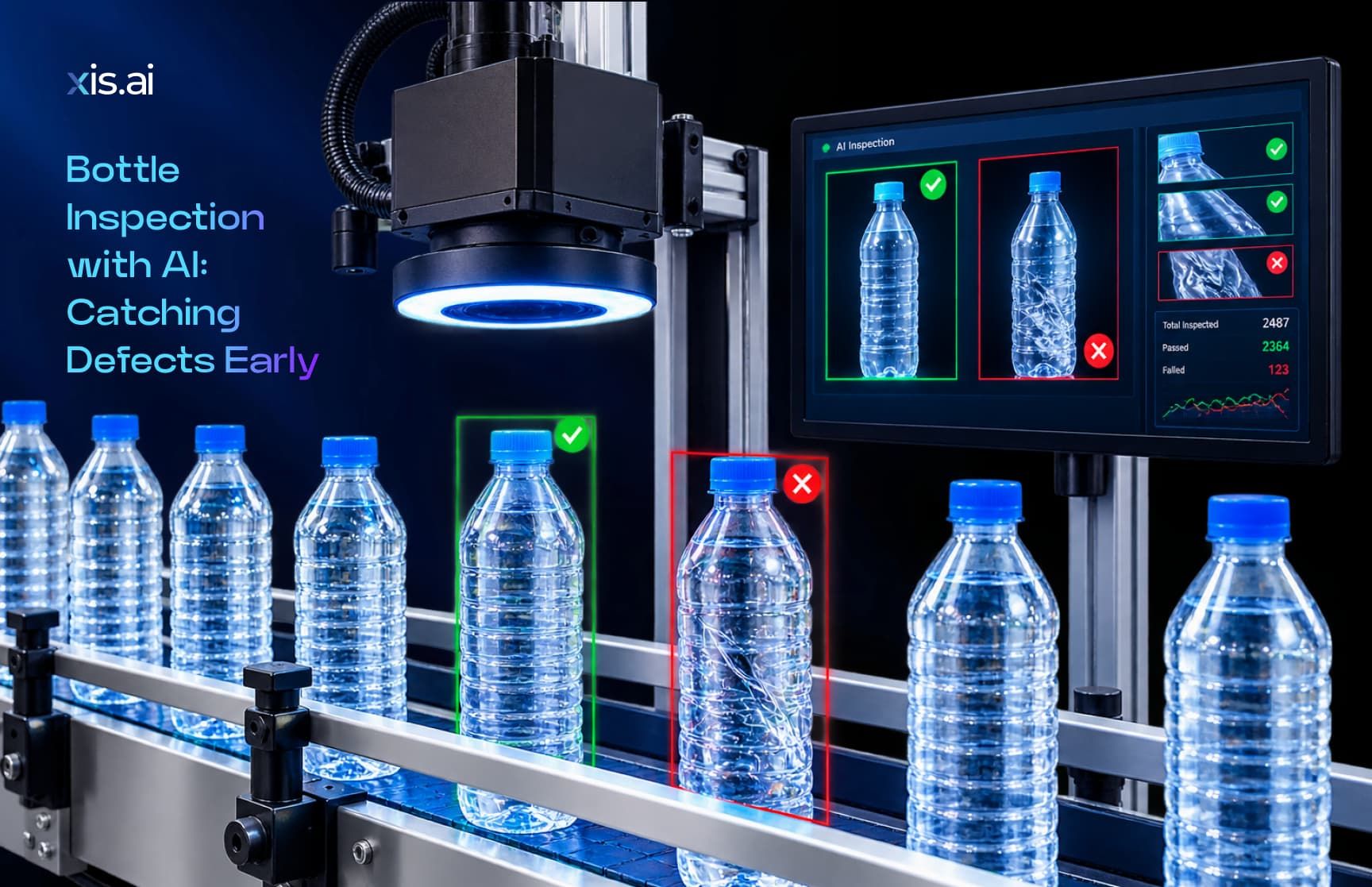
Bottles that leave a filling line with an invisible crack, a contamination residue, or a shape deviation rarely get caught by a quick visual check. By the time the defect surfaces, whether as a leak on a retail shelf or a rejected pallet at a downstream customer, the cost of the failure has already multiplied several times over. Bottle inspection exists to catch these defects at the point of production, but the method used to do it determines whether that catch happens reliably or only some of the time.
This is the core problem manufacturers are working through as production speeds increase and bottle designs diversify: traditional inspection methods were built for a slower, more uniform production environment, and they are increasingly asked to do a job they were not designed for.
The Problem: How Bottle Defects Slip Past Traditional Inspection
Manual visual checks depend on consistent attention across long shifts, at line speeds where a single bottle may be visible for less than a second. Fatigue, lighting inconsistency, and the sheer repetitiveness of the task all work against accuracy, and defect rates tend to climb noticeably toward the end of a shift even when nothing about the production process has changed.
Rule-based machine vision systems address some of this by automating the check itself, but they carry a different limitation. These systems compare bottles against a fixed set of programmed tolerances, which means they perform well against known, previously catalogued defect types and poorly against anything outside that set. A new contamination pattern, a subtle mold-line shift, or a defect that only appears under specific lighting conditions can pass through undetected simply because it was never explicitly defined as a rejection criterion.
The result is a gap between what inspection systems are catching and what defects are actually reaching the packaging line, and that gap tends to widen as SKU variety increases and production runs shorten.
Bottle Defect Detection: What AI Actually Catches
AI-based bottle defect detection closes this gap by learning the visual range of an acceptable bottle rather than checking against a fixed list of known flaws. Trained on production imagery, the model identifies deviations that fall outside the learned standard, which allows it to flag defect types it has not been explicitly programmed to look for. This distinction matters most for the defect categories that traditional systems consistently miss:
- Hairline cracks that are visible only under specific angles or lighting
- Contamination residue inside clear or lightly tinted bottles
- Shape deviations from mold wear or material inconsistency
- Surface scratches and haze that affect clarity without an obvious edge
Because the model continues learning from ongoing production data, its accuracy improves over time without requiring a manual rewrite of inspection rules each time a new bottle design or material enters the line.
Bottle Surface Inspection: Finding Cracks, Chips, and Contamination
Surface-level defects account for a large share of bottle rejections, and they are also the category where lighting and camera positioning matter most. A crack that shows clearly under one angle of illumination can be nearly invisible under another, which is why AI-based bottle surface inspection is typically paired with carefully specified lighting rather than a single fixed camera setup.
The system captures images at multiple points around the bottle surface, allowing the model to evaluate cracks, chips, and contamination from more than one perspective before a pass or reject decision is made. This reduces the false negatives that occur when a defect happens to face away from a single fixed camera angle, a limitation that manual inspection and single-camera rule-based systems share.
Bottle Inspection Systems: How They Work on the Line
A complete bottle inspection system combines four elements working together: cameras positioned to capture full bottle coverage, lighting specified for the material and defect types involved, an AI model trained on the specific bottle design in production, and integration with the line's reject mechanism so that flagged bottles are removed without slowing throughput.
Edge AI deployment, where the inspection model runs directly on local hardware positioned at the line rather than sending images to a centralized server, keeps this decision loop fast enough to operate at full production speed. Platforms such as xis.ai deploy inspection models this way specifically to avoid the latency that would otherwise create a bottleneck at high-speed filling and capping lines. For a closer look at how these hardware and software components fit together, see Industrial Vision Systems Explained: Components, Benefits, and Applications.
Bottle Quality Inspection at Scale: Handling SKU Variation and Speed
Manufacturers running multiple bottle designs on the same line face a specific version of this problem: a rule-based system tuned for one bottle shape often needs to be reprogrammed, at least partially, when the line switches to a different SKU. This reprogramming cycle costs time that a high-mix production environment cannot always absorb.
AI-based bottle quality inspection reduces this friction because the underlying model generalizes across visual patterns rather than depending on fixed rules for a single bottle geometry. Retraining for a new SKU typically means adding labeled examples of the new bottle design rather than rebuilding the inspection logic from the start. This same no-code retraining approach is covered in more detail in AI Inspection Software for Automated Quality Control, which addresses how AI inspection software adapts to production variability more broadly.
For bottles containing opaque liquids or requiring an internal integrity check, X-ray-based inspection extends this same principle beneath the surface. AI Defect Detection in FMCG: Catching What Humans Miss covers how X-ray imaging identifies internal voids, fill inconsistencies, and foreign objects that surface-level cameras cannot detect on their own.
Building a Reliable Bottle Vision Inspection Process
Solving the bottle inspection problem is less about replacing every existing check at once and more about identifying where the current process is losing the most defects. Manufacturers typically start by reviewing which defect categories are showing up in downstream complaints or field returns and mapping those back to the point in the line where they should have been caught. From there, a bottle vision inspection deployment can be scoped around the specific gap rather than a generic template. A broader look at how this technology applies across production environments is available in AI Visual Inspection: Technology, Benefits & Applications.
Frequently Asked Questions
What defects can AI bottle inspection detect that manual checks miss?
AI bottle inspection catches hairline cracks, contamination residue, shape deviations, and surface haze that manual review often misses due to fatigue, line speed, or inconsistent lighting angles.
Can AI bottle inspection handle multiple bottle designs on the same line?
Yes. Because the model generalizes from learned visual patterns rather than fixed rules, adding a new bottle design typically requires labeled training examples rather than a full system rebuild.
Does bottle inspection require X-ray imaging, or is surface camera inspection enough?
It depends on the defect type. Surface camera inspection catches external cracks, chips, and contamination, while X-ray-based inspection is needed to detect internal voids or fill inconsistencies inside opaque or sealed bottles.
How fast can AI bottle inspection run without slowing the production line?
Edge AI deployment runs inspection models directly on local hardware at the line, keeping detection decisions fast enough to match full production speed without creating a bottleneck.
Does AI bottle inspection replace existing machine vision systems entirely?
Not necessarily. AI-based inspection is often deployed alongside existing machine vision or Automated Optical Inspection systems, adding the ability to catch defect types that fixed-rule systems were not programmed to identify.
Comment
0Comments
No comments yet.