Cap Inspection with AI: Catching Missing Caps and Seals

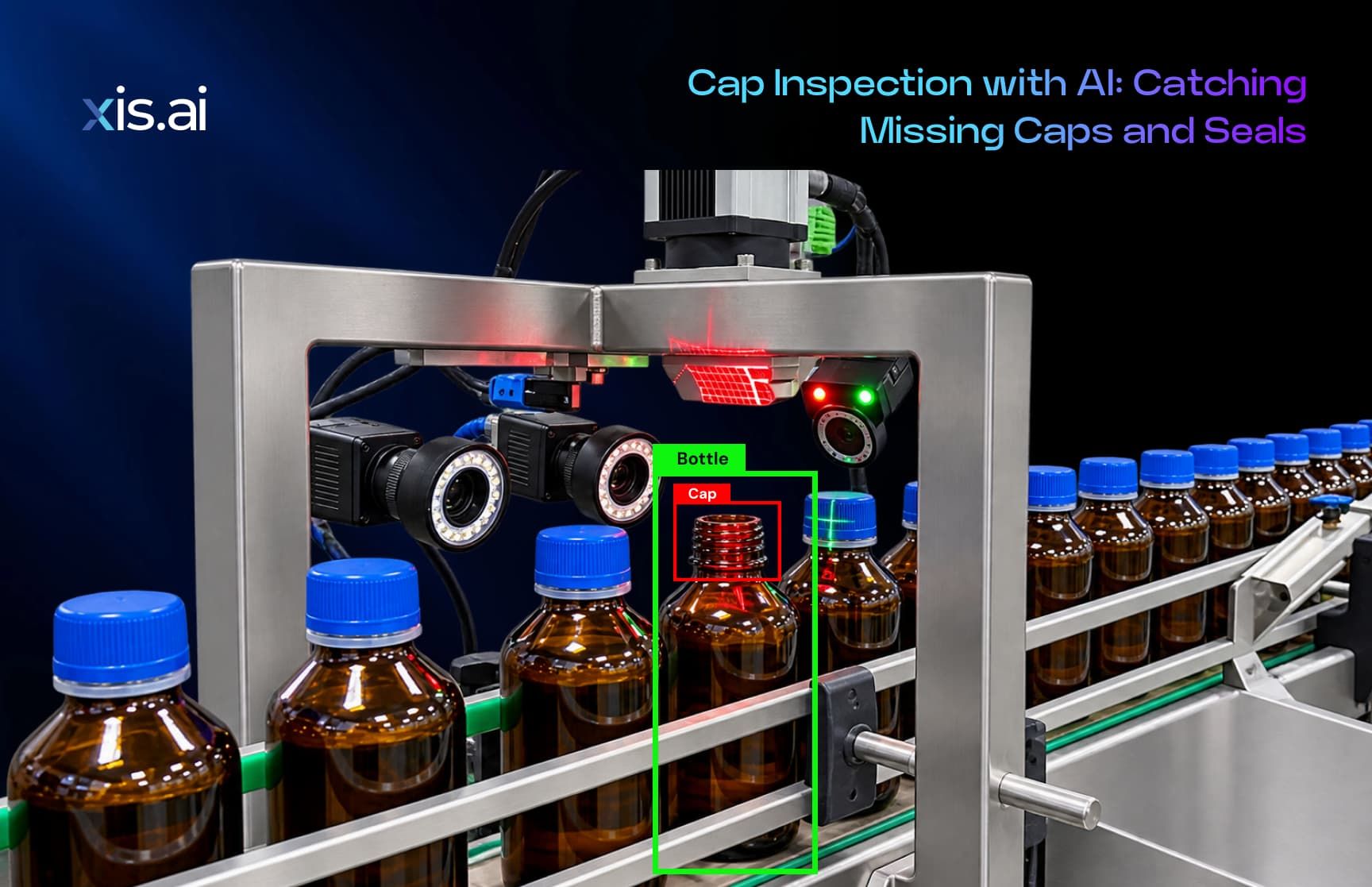
Cap inspection is the automated visual examination of bottle or container closures to confirm that each cap is present, correctly aligned, fully seated, and properly sealed before the unit leaves the production line. It sits at the intersection of two quality concerns that manufacturers cannot afford to treat separately: product presentation and product integrity, since a cap defect that looks minor on the shelf often signals a seal failure that compromises shelf life underneath it.
This blog defines what cap inspection actually checks, explains how AI-based systems perform that check differently from traditional methods, and walks through where the technology applies across bottled and packaged products.
What Cap Inspection Actually Checks
A cap inspection system evaluates several distinct failure modes at once, not a single pass-fail condition. The most common issues include missing caps entirely, caps that are present but not fully seated, caps installed at an angle rather than square to the bottle neck, and caps that appear correctly placed but fail to create an adequate seal underneath. As covered in AI Industrial Seal Inspection for Packaging Quality and Seal Integrity, seal integrity is frequently the defect category that routine visual checks overlook, since a cap can appear visually correct while the seal beneath it has failed.
Each of these defect types carries a different downstream risk. A missing cap is an obvious rejection. A misaligned or poorly seated cap may pass a quick glance but leak during transport or shorten shelf life through oxygen exposure. This is why cap inspection, done properly, needs to evaluate placement and seal quality together rather than treating visible presence as sufficient confirmation.
How AI-Based Cap Inspection Works
Traditional rule-based vision systems check cap position against a fixed geometric tolerance, comparing camera output to a predefined template. This approach performs reliably when bottle designs and cap types remain constant, but it struggles as soon as a production run introduces a new bottle shape, a different cap color, or lighting variation between shifts.
AI-based cap inspection instead learns the visual range of a correctly capped bottle from labeled production images, then flags deviations that fall outside that learned standard. This allows the system to catch alignment and seating defects that fall short of an obvious geometric mismatch, the kind of subtle deviation a fixed-rule system is prone to pass through. Dairy production lines illustrate this well: as outlined in AI Dairy Packaging Defect Detection: Improving Quality Control With Intelligent Inspection, cap and closure verification is treated as its own dedicated check within the broader packaging inspection process, precisely because closure failures on bottled dairy products lead directly to leakage and spoilage.
Edge AI deployment supports this process by running the inspection model directly on hardware positioned at the capping station, allowing the pass-reject decision to happen within the same production cycle rather than introducing a delay that would slow the line.
Where Cap Inspection Applies Across Production
Cap inspection is not limited to a single product category. Beverage and dairy bottling lines rely on it to prevent leakage and contamination, cosmetics and personal care manufacturers use it to protect both product integrity and shelf presentation, and pharmaceutical packaging depends on it as a compliance requirement rather than an optional quality check. In each case, the underlying technology performs the same function: verifying that a closure meets the standard required for that product category, whether the primary concern is food safety, tamper evidence, or brand presentation. AI-Powered Food Packaging Inspection: How Vision AI Protects Food Brands from Packaging Failures covers how missing or misaligned caps fit into a broader packaging inspection strategy alongside seal gaps and fill-level errors, since these defect categories tend to appear together on the same production line rather than in isolation.
For products where the cap seals an opaque or sealed container, surface-level cameras alone cannot always confirm seal integrity underneath. In these cases, internal imaging methods extend the inspection beneath what a camera can see externally, a capability discussed further in AI Defect Detection in FMCG: Catching What Humans Miss, which addresses how X-ray-based inspection identifies internal voids and misaligned closures that surface cameras miss on sealed FMCG products.
What a Cap Inspection Deployment Looks Like in Practice
Implementing cap inspection typically starts with identifying where in the line closure defects most often go undetected, whether that is immediately after capping, before labeling, or at final packaging. Cameras are positioned to capture the cap and neck area from angles sufficient to evaluate both placement and visible seal integrity, and the AI model is trained on labeled examples specific to the bottle and cap combination in production. Because the model generalizes from these examples rather than depending on fixed geometric rules, adding a new cap color or bottle design to the production mix typically means expanding the training set rather than reprogramming the inspection logic from the start.
Frequently Asked Questions
What defects does AI cap inspection detect?
AI cap inspection detects missing caps, misaligned or unseated caps, and seal integrity failures that may not be visible through a quick manual check.
How is AI cap inspection different from traditional rule-based inspection?
Traditional systems compare cap position against a fixed geometric template, while AI-based systems learn the visual range of a correctly capped bottle and flag deviations, allowing them to catch subtler alignment and seal defects.
Can cap inspection detect seal problems that are not visible from the outside?
Surface-level cameras can confirm visible placement and alignment, but internal seal failures inside opaque or sealed containers often require internal imaging methods to confirm integrity beneath the cap.
Does cap inspection need to be retrained for every new bottle or cap design?
Adding a new bottle or cap design typically requires expanding the labeled training set rather than rebuilding the inspection system, since the AI model generalizes from learned patterns.
Which industries rely most on AI cap inspection?
Beverage and dairy bottling, cosmetics and personal care, and pharmaceutical packaging all depend on cap inspection, though the primary concern shifts between contamination prevention, product presentation, and regulatory compliance depending on the industry.
Comment
0Comments
No comments yet.