

What
What is a Vision Inspection System & How It Works?
xis.ai
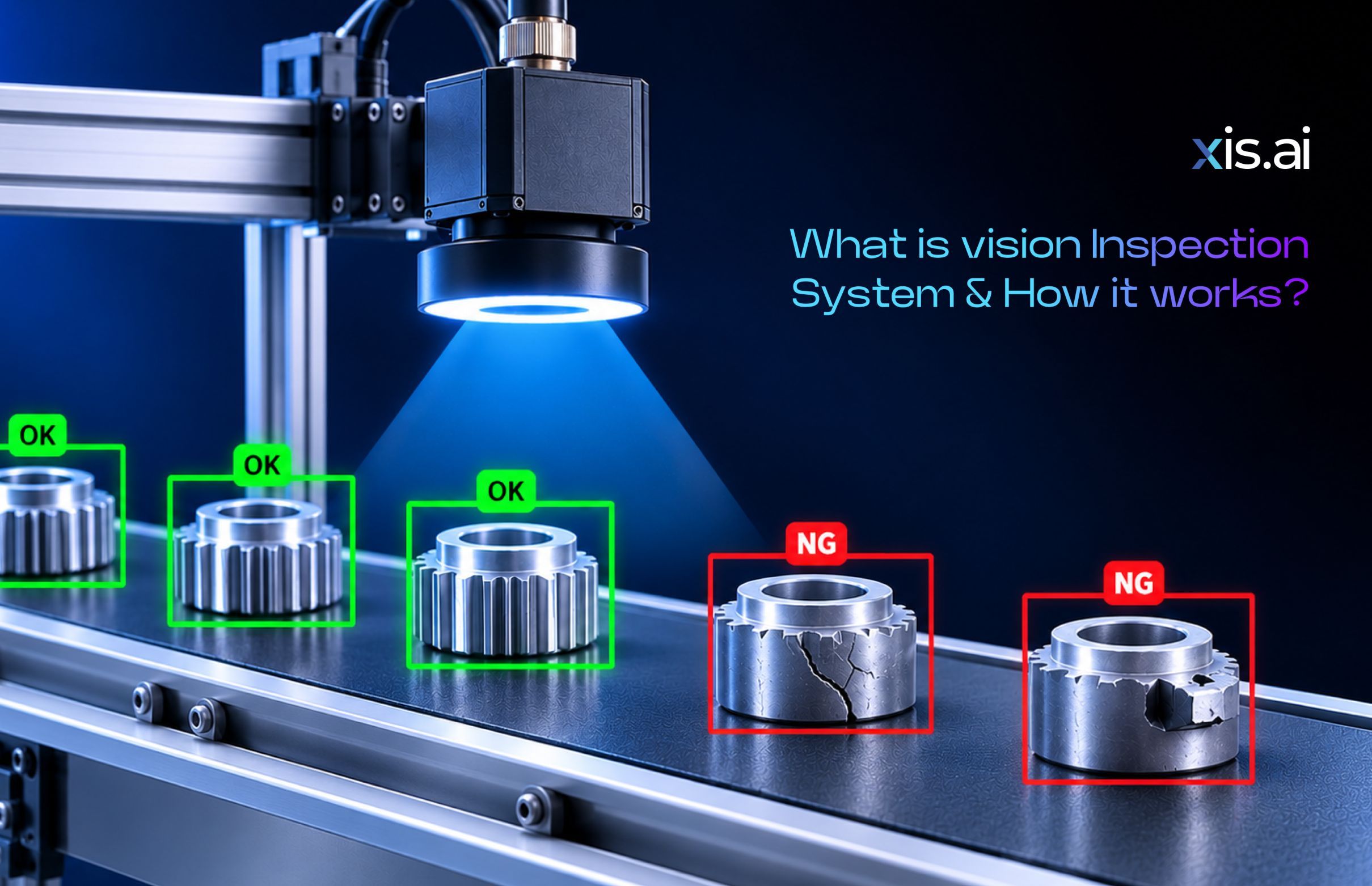
Manual inspection cannot keep up at line speed, and whatever it misses reaches the customer. An automated visual inspection system closes that gap, but only when it is set up correctly.
This guide explains what a vision inspection system is, what it can check, how it works, how AI compares with traditional machine vision, and how xis.ai builds systems that hold up on a live production line.
What is a Vision Inspection System?
A vision inspection system, also known as an industrial vision system or machine vision system, is an automated quality control system that checks every product on a production line using cameras, lighting, optics and software.
It captures an image of each unit, analyzes it and decides in real time whether the unit passes or fails.
Vision Inspection vs Manual Inspection
Manual inspection typically involves sampling, since it's impractical to inspect each unit at production speed. With higher speeds and tighter tolerances, more defects will fall through between the samples.
The vision inspection system inspects all of the units at line speed, rather than a representative sample and maintains a record of each decision.
What Can a Vision Inspection System Check?
There are essentially a few groups of inspection tasks that occur on a production line:
- Defect and Anomaly Detection: Surface flaws, damage, contamination and anything that doesn't resemble a good unit.
- Presence and Assembly Checks: To and ensure that all components are present and that the assembly is complete.
- Label and Code Verification: Ensuring labels and printed codes/barcodes are there, correct, and readable.
- Seal and Packaging Checks: Ensuring that seals, fill and packaging are in place.
- Measurement: Verifying positions and dimensions with tolerances.
- Object Detection and Classification: Identifying the product or feature in the image and categorizing by type (product variant or defect class).
These can be performed concurrently on the same system, if the system is well designed.
How Does a Vision Inspection System Work?
A vision inspection system is like a chain, with each link being dependent on the previous link:
- Light the Product: Controlled lighting highlights features of interest, with no shadows or glare, as each product arrives at the inspection point.
- Capture the Image: A picture of the unit is captured by an industrial camera and lens at the line's desired resolution and speed.
- Process the Image: In the industrial pc at the line or in a central system, the image is processed and analyzed.
- Make the Decision: Rule-based vision tools or an AI model compare the unit to a good unit and determine if it passes or fails.
- Act on the Result: The decision passes to the PLC, MES or dashboard, which rejects the part, raises an alarm, or stops the line.
Core Components of a Vision Inspection System
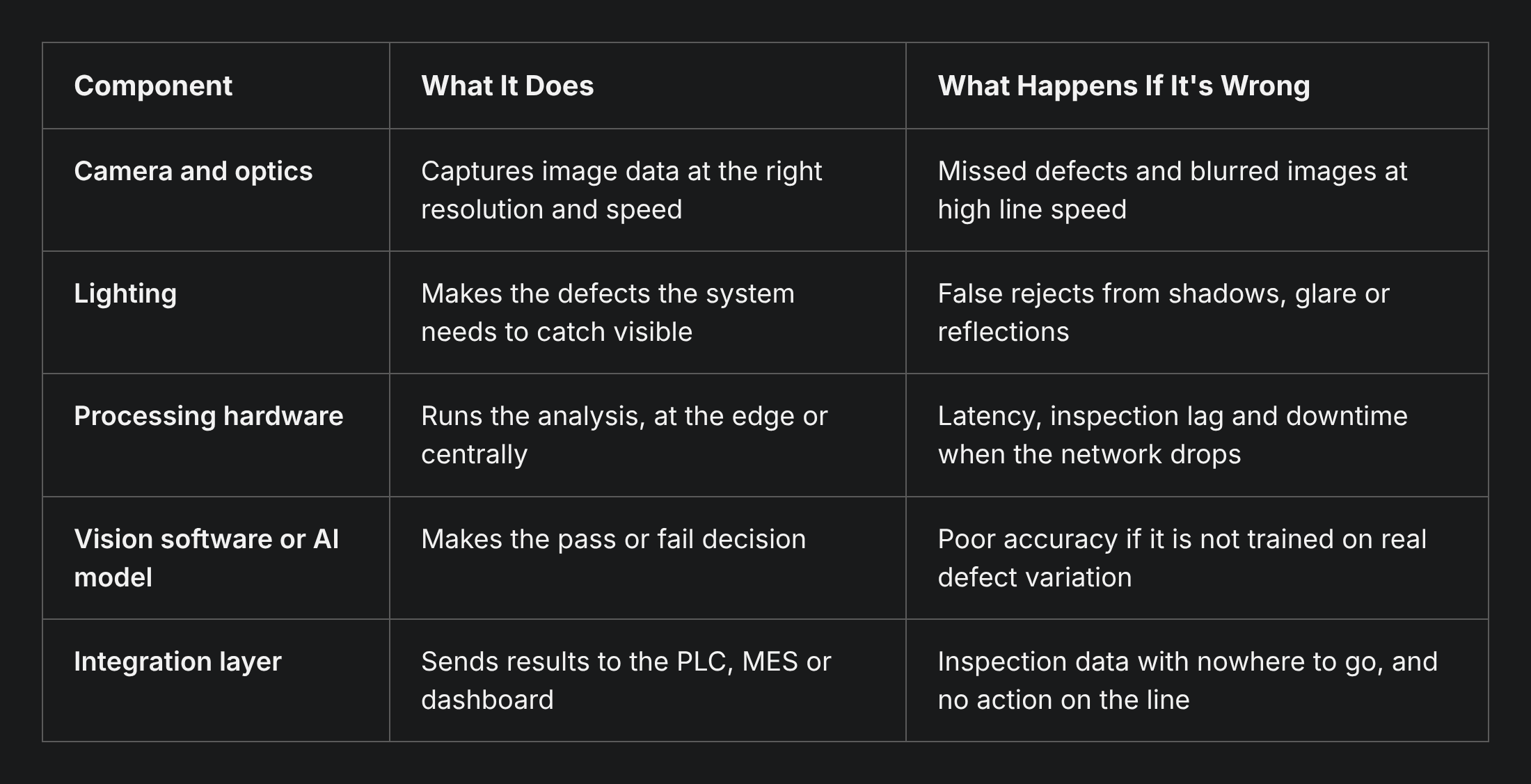
Here's a breakdown of the core components of a vision inspection system, what each one does and what goes wrong when it isn't specified correctly:
AI Visual Inspection vs Rule-Based Machine Vision
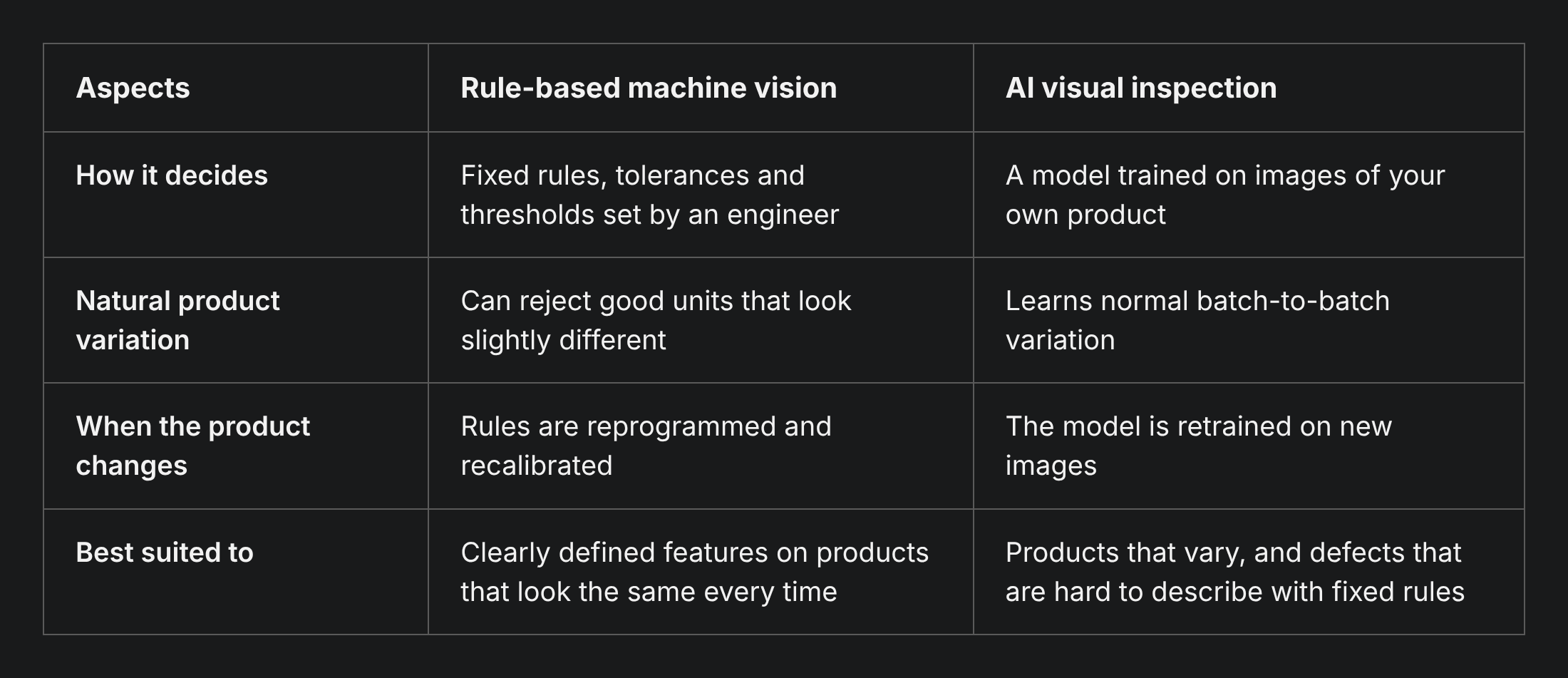
Vision inspection software makes its pass or fail decision in one of two ways: with fixed rules programmed by an engineer, or with an AI model trained on images of the product.
Here's how the two approaches compare:
Benefits of Industrial Vision Systems
Industrial machine vision delivers three main benefits for quality teams:
- Early Defect Detection: Defects caught on the line before they become a customer complaint or return.
- Human inspection: No matter how skilled, human inspectors can be fatigued and lose their concentration. A well-maintained vision system uses the same criteria for the first half of a shift as for the ten-thousandth.
- Root Cause Analysis: Vision systems can record inspection data at all times and the data is used as a diagnostic tool. A frequent placement error, for instance, might indicate that a feeder mechanism has worn out, but hasn't sent a maintenance alert.
Machine Vision Applications Across Manufacturing
Machine vision inspection is used wherever quality has to be checked reliably at line speed. Common machine vision applications include:
- Electronics: Solder joint inspection, component placement and PCB defect detection
- Metal and Machining: Surface defect detection, dimensional verification and weld quality assessment
- Automotive: Surface finish, assembly completeness and component presence
- Food and Bakery: Packaging integrity, label verification and foreign object detection
- Pharmaceutical: Blister pack inspection, seal verification and compliance checks
- Consumer Goods: Label, code, fill and seal verification on fast lines
- Logistics and Packaging: Carton damage detection and label and barcode verification at scale
For more detail on each sector, see how xis.ai approaches vision inspection by industry.
How to Get a Vision Inspection System Right
The most frequent error manufacturers make is to consider the software the entire answer. Even the most sophisticated algorithm will not perform well with a poorly trained model and/or incorrect camera resolution.
Define the Inspection Requirements
To get the specification right, one needs to begin with the physical inspection problem such as part size, type of defect, line speed and environmental conditions. Develop the hardware to solve the problem first, and then add the AI software.
Camera, Lighting and Optics Selection
The camera and optics determine if the system gets sufficient detail at line speed. Machine vision lighting is deserving of the same attention. The most frequent area where vision systems are unable to perform on a production line is illumination; and the most common reason for false rejects and missed defects is inconsistent illumination.
Troubleshooting a vision inspection system
Lighting Consistency: Has anything changed near the line, such as new equipment, window glare or shift-dependent lighting?
- Camera Position: Has the mounting shifted, even slightly?
- Training Data: Has the product design or material changed since the model was last trained?
- Integration Lag: Is the PLC receiving and acting on flagged results in time?
Most AI accuracy problems reported on the floor turn out to be lighting or positioning issues, not model issues.
How Does xis.ai Build Vision Inspection Systems That Work on Your Line?
xis.ai builds edge AI visual inspection systems around the same principle: start with the inspection problem, then match the hardware, AI models and line integration to it, rather than adapting a generic template.
xis.ai Inspection Hardware
- Industrial camera: Standard industrial cameras and interfaces, with nothing proprietary.
- Controlled lighting: Specified as part of each inspection design.
- Industrial PC with an NVIDIA GPU: Placed at the line, running the AI model locally with no cloud connection.
In most cases, xis.ai can also be retrofitted onto the cameras, lighting and industrial PCs already on your line.
xis.ai Inspection Software
- xis.dev: A no-code tool where your quality and process engineers build models on images of your own product and retrain them when the product changes.
- xis.rt: Runs the models at each inspection point at 150 frames per second and signals reject, alarm or line halt to your PLC and MES over OPC-UA and MQTT.
- xis.dashboard: Brings inspection results, images and data from every line, plant and country into one view, hosted on your own servers. It turns that data into actionable insights, such as defect trends, recurring failure patterns and line-by-line performance, so your teams can act on problems earlier, reduce scrap and optimize production.
Why xis.ai Works on Real Production Lines
- Lighting Validation: Specified and validated against the lighting your line actually has, morning, night and through the seasons.
- Product-Specific Training: Learns from what really comes off your line, including natural batch-to-batch variation.
- Line-Speed Validation: Validated at the speed your line really runs, before anything goes into production.
- On-Site Processing: Runs on an edge device in your facility, with no cloud, no internet needed and no images leaving your network.
Is Your Line Ready for an xis.ai Vision Inspection System?
Many vision inspection problems start at the specification stage, long before the system goes live. xis.ai helps you get that stage right by testing your product first. Send us 20 images of the defect you need to catch, and our engineers will train a model and tell you whether that defect can be detected reliably.
If the results meet your requirements, the next step is a pilot on one production line, running alongside your current inspection so you can compare the two before you commit.
Frequently Asked Questions
What is machine vision?
Machine vision is technology that lets machines see and evaluate objects using cameras, lighting and software. In manufacturing, it is used to inspect products, read codes and measure parts automatically on the production line.
Is machine vision AI?
Not always. Traditional machine vision follows fixed rules set by an engineer, while AI-based machine vision uses models trained on images to recognize defects and handle natural product variation.
What is the difference between machine vision and computer vision?
Computer vision is the broader field of teaching computers to understand images. Machine vision applies it in industrial settings, using cameras and processing hardware to make decisions on a production line.
What is a machine vision camera?
A machine vision camera is an industrial camera built to capture sharp images of moving products at high speed. Unlike a regular camera, it is designed for continuous use on the factory floor.
Can machine vision be added to an existing production line?
Yes, in most cases. Vision systems can be installed on existing conveyors and connected to the line's PLC, so the line usually does not need to be redesigned.