AI Syringe Defect Detection in Pharmaceutical Manufacturing

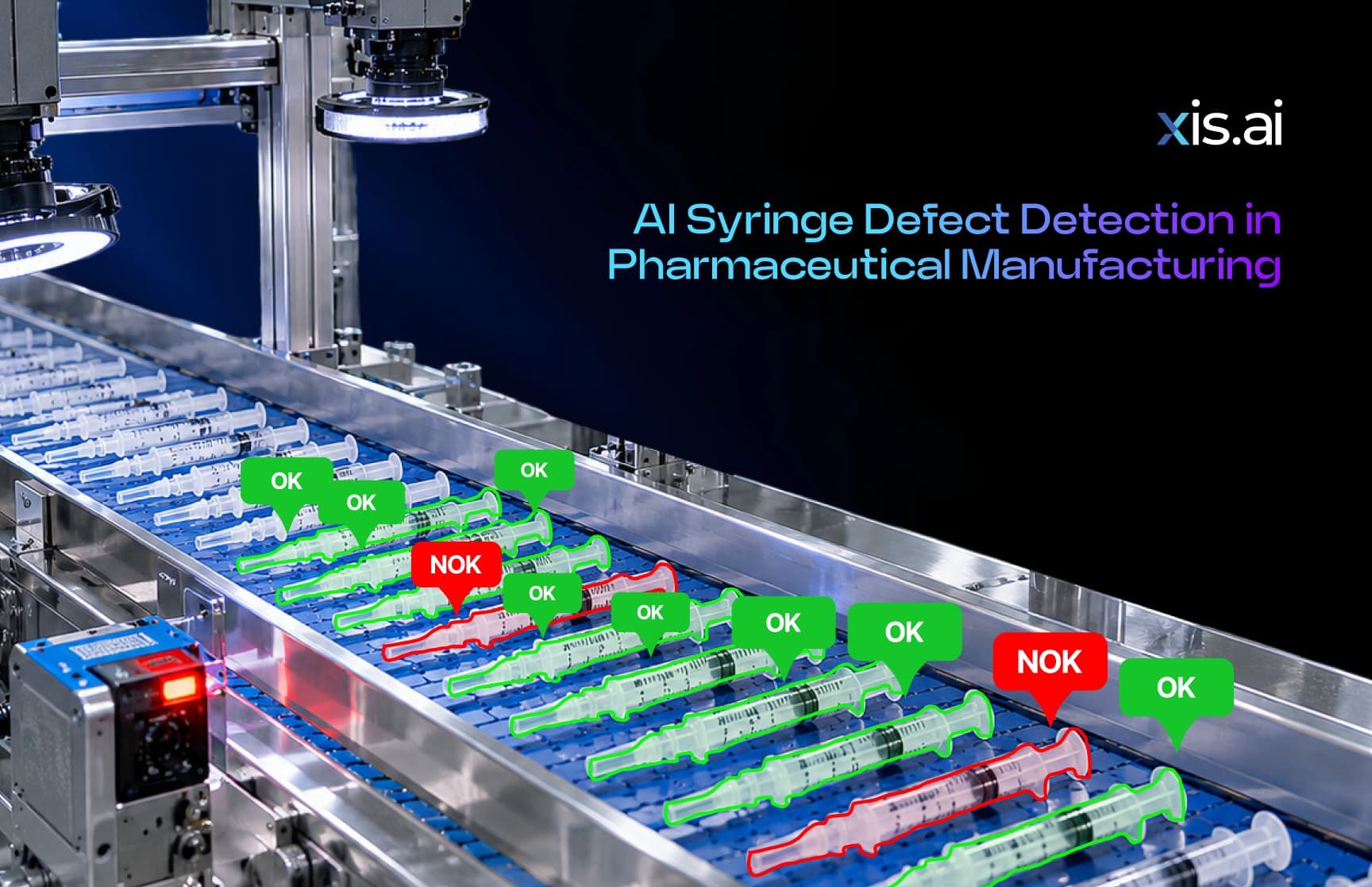
In pharmaceutical manufacturing, even the smallest defect can become a major safety risk. A microscopic crack in a syringe barrel, an incorrect fill level, a damaged needle, or contamination inside injectable packaging can compromise product integrity and patient safety.
As pharmaceutical production scales globally, manufacturers face increasing pressure to maintain strict quality standards while improving production efficiency. Manual inspection methods and traditional rule-based systems often struggle to deliver the consistency, precision, and speed required in modern injectable manufacturing lines.
This is why pharmaceutical companies are increasingly adopting AI-powered syringe inspection systems to automate visual quality control processes.
Using computer vision and machine learning, these systems can inspect syringes at high speeds, detect tiny defects with remarkable accuracy, and support compliance with strict pharmaceutical regulations.
For manufacturers producing injectable drugs, vaccines, biologics, and prefilled syringes, AI inspection is rapidly becoming an essential part of pharmaceutical quality assurance.
Why Syringe Inspection Is Critical in Pharmaceutical Manufacturing
Syringes are among the most sensitive pharmaceutical packaging components.
Unlike many other product types, injectable products are directly administered into the human body. Even a small defect can lead to contamination risks, dosage inaccuracies, leakage, or product recalls.
Pharmaceutical manufacturers must therefore inspect syringes for a wide range of quality issues before products reach the market.
Common inspection targets include:
- Cracked syringe barrels
- Needle defects
- Improper plunger placement
- Cosmetic packaging damage
- Fill-level inconsistencies
- Foreign particle contamination
- Labeling errors
- Seal integrity issues
- Missing components
Traditional manual inspection processes often struggle to identify subtle defects consistently, particularly in high-speed manufacturing environments where thousands of syringes are processed every minute.
This has accelerated the adoption of AI-driven pharmaceutical defect detection systems capable of performing automated, high-precision inspections in real time.
For a broader understanding of how AI improves industrial defect analysis across manufacturing sectors, explore How xis.ai Detects Defects in Metal Parts → learn how AI models identify microscopic industrial defects with high precision
What Is an AI Syringe Inspection System?
A syringe inspection system is an automated visual inspection solution that uses artificial intelligence, computer vision, and industrial imaging technology to identify defects in syringes and injectable packaging during pharmaceutical production.
The system typically combines:
- High-resolution industrial cameras
- AI vision software
- Deep learning algorithms
- Automated rejection systems
- Real-time production line integration
As syringes move through production lines, cameras capture images from multiple angles. AI models analyze these images instantly to identify visible and microscopic defects.
Unlike conventional machine vision systems that rely on predefined rules, AI-based systems learn from large volumes of inspection data and adapt to varying syringe types, materials, and manufacturing conditions.
This makes AI inspection especially valuable in complex pharmaceutical environments.
Readers interested in the broader architecture behind these systems can also explore AI Vision Inspection System Overview → understand how AI inspection workflows operate in industrial production environments
Types of Syringe Defects AI Can Detect
Modern medical syringe inspection AI systems are capable of detecting a wide variety of manufacturing and packaging defects.
Cracks and Structural Damage: AI systems can identify tiny cracks or fractures in syringe barrels that may not be visible during manual inspection.
Needle Defects: Bent, damaged, or improperly attached needles can be detected automatically before products leave the production line.
Fill-Level Variations: Computer vision algorithms verify whether injectable products contain the correct liquid volume.
Foreign Particle Detection: AI inspection systems can identify visible contaminants or particles inside syringes and injectable containers.
Stopper and Plunger Defects: Incorrectly positioned or damaged plungers and stoppers can affect dosage accuracy and sterility.
Cosmetic Packaging Defects: AI systems also inspect
- Label placement
- Packaging alignment
- Surface scratches
- Printing errors
- Seal integrity
This supports complete injectable packaging inspection throughout pharmaceutical production.
Similar AI-driven visual inspection technologies are also widely used in automated packaging quality control applications. AI Vision Inspection for Damaged Cartons in Modern Warehouses → see how AI detects packaging defects in high-speed logistics environments
Challenges in Traditional Syringe Inspection
Pharmaceutical manufacturers have historically relied on manual inspection or conventional rule-based machine vision systems.
However, these approaches create several operational limitations.
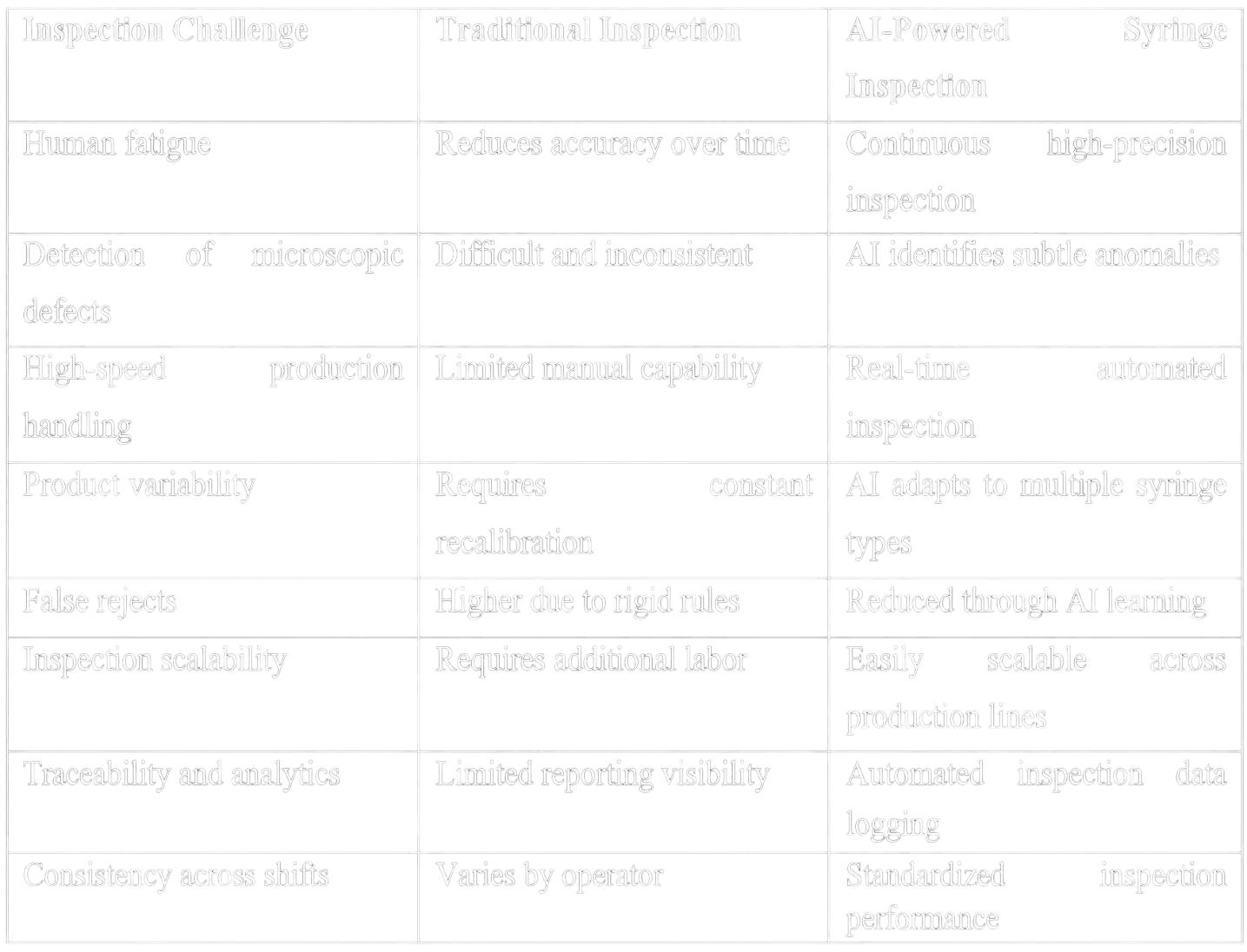
This is why pharmaceutical manufacturers are increasingly replacing manual inspection processes with AI-powered pharmaceutical defect detection systems.
Benefits of AI-Powered Injectable Packaging Inspection
The adoption of AI-based injectable packaging inspection provides several operational and quality advantages for pharmaceutical manufacturers.
Improved Product Quality: AI systems help detect defects early before products reach downstream packaging or distribution.
Higher Inspection Accuracy: Deep learning models can identify defects that are difficult for human inspectors to detect consistently.
Increased Production Efficiency: Automated inspection supports high-speed production lines without creating bottlenecks.
Reduced Product Recalls: Early defect detection minimizes the risk of defective products reaching the market.
Better Regulatory Compliance: AI inspection systems improve traceability and documentation for pharmaceutical quality assurance processes.
Lower Operational Costs: Automation reduces manual inspection dependency while improving production consistency.
How xis.ai Supports Pharmaceutical Visual Inspection
xis.ai develops AI-powered computer vision solutions that help pharmaceutical manufacturers automate complex visual inspection processes.
For injectable manufacturing environments, xis.ai can support:
- AI-powered syringe inspection systems
- Medical syringe inspection AI
- Injectable packaging inspection automation
- Pharmaceutical defect detection systems
- High-speed production line inspection integration
- AI-driven quality analytics and reporting
By combining machine learning with scalable computer vision technology, xis.ai enables pharmaceutical manufacturers to improve defect detection accuracy, strengthen quality control, and support efficient high-volume production.
Automated syringe inspection helps manufacturers maintain strict pharmaceutical standards while reducing operational inefficiencies and inspection variability.
Why AI Inspection Is Becoming Essential in Pharma Manufacturing
Pharmaceutical manufacturing is becoming increasingly automated, data-driven, and quality-focused.
As production volumes rise and regulatory expectations become stricter, manufacturers need inspection systems capable of delivering consistent, scalable, and highly accurate quality control.
AI-powered visual inspection provides the precision and adaptability required for modern injectable manufacturing environments.
For pharmaceutical companies aiming to improve quality assurance, reduce recalls, and modernize production workflows, implementing an intelligent syringe inspection system is rapidly becoming a strategic necessity rather than an optional upgrade.
Frequently Asked Questions
What Is A Syringe Inspection System?
A syringe inspection system uses AI vision technology and industrial cameras to automatically detect defects in syringes during pharmaceutical manufacturing.
How Does Medical Syringe Inspection AI Work?
Medical syringe inspection AI analyzes syringe images using deep learning algorithms trained to identify cracks, contamination, fill-level issues, and packaging defects.
Why Is Injectable Packaging Inspection Important?
Injectable packaging inspection helps ensure pharmaceutical safety, packaging integrity, dosage accuracy, and regulatory compliance.
What Defects Can AI Detect In Pharmaceutical Syringes?
AI inspection systems can detect cracks, needle defects, contamination, fill-level inconsistencies, stopper issues, labeling errors, and cosmetic packaging damage.
What Is A Pharmaceutical Defect Detection System?
A pharmaceutical defect detection system is an AI-powered inspection solution that automatically identifies manufacturing and packaging defects during pharmaceutical production.
Comment
0Comments
No comments yet.