Tablet Inspection in Pharma: Chips, Cracks, Shape Defects

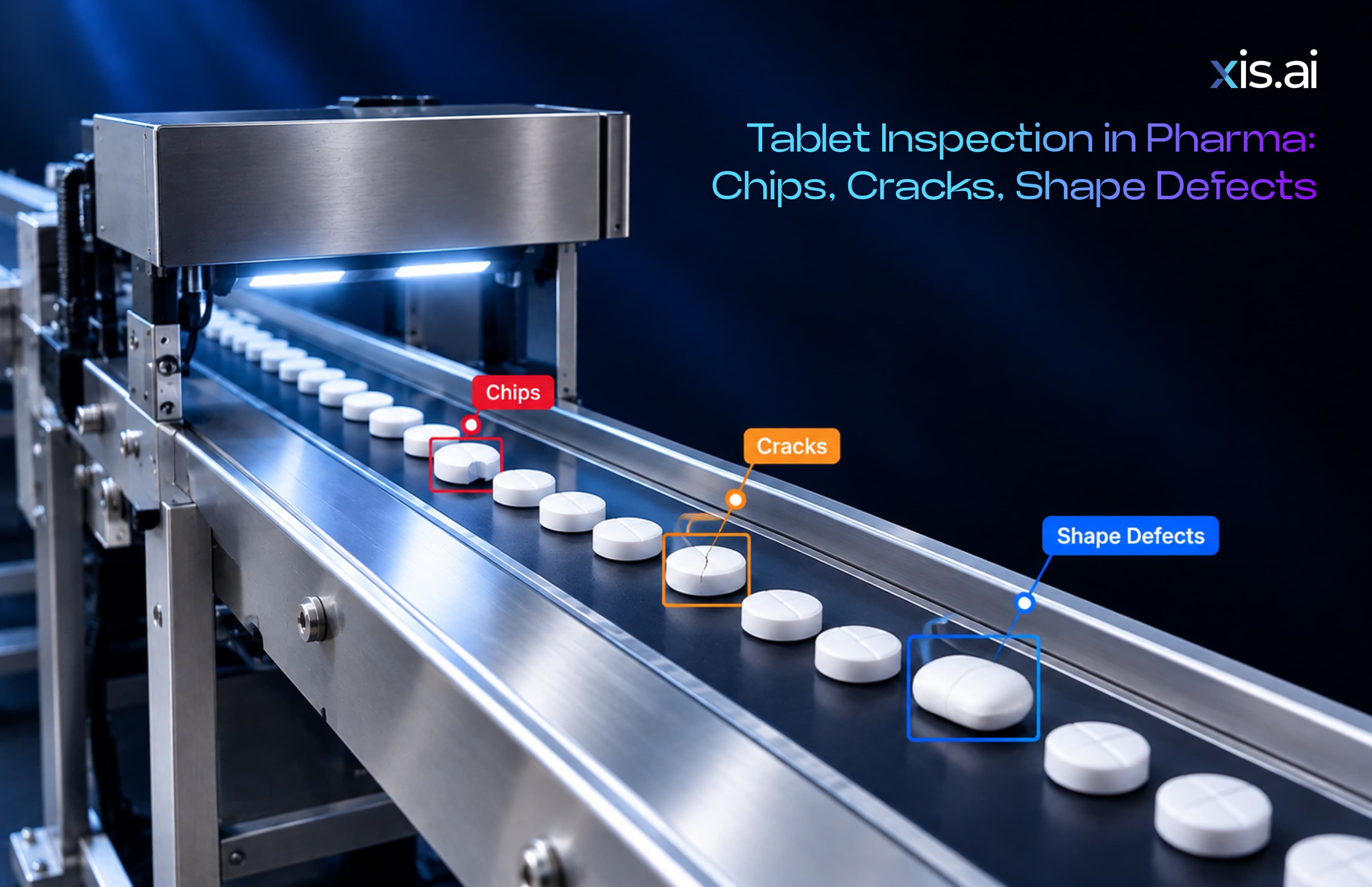
Tablet inspection in pharmaceutical manufacturing is typically handled through one of three approaches: manual visual sampling, rule-based Automated Optical Inspection, or AI-based visual inspection. Each method inspects the same core defect categories, chips, cracks, shape deviations, discoloration, and contamination, but the three differ sharply in coverage, consistency, and how well they hold up as production speed and tablet variety increase. This piece compares the three approaches directly, criterion by criterion, so the trade-offs are clear rather than assumed.
Defect Coverage: What Each Method Actually Catches
Manual visual sampling relies on trained inspectors reviewing a percentage of tablets against a known defect reference. This catches obvious defects reliably, but samples only a fraction of total output, meaning defective tablets outside the sampled batch reach packaging undetected. As covered in AI for Pharmaceutical Blister Pack Inspection, broken tablets, chipped edges, and double-filled cavities are among the defect types that slip through sampling-based checks most often, precisely because sampling by design leaves gaps.
Rule-based Automated Optical Inspection improves sampling by checking every unit, but it compares each tablet against a fixed geometric and color template. This performs well for a single, unchanging tablet design and struggles at the moment a manufacturer runs multiple SKUs with different shapes, colors, or coatings on the same line, since the rule set has to be rebuilt for each variant.
AI-based tablet inspection learns the acceptable visual range of a tablet from labeled production images rather than depending on a fixed template. This allows it to catch subtle chips, hairline cracks, and shape deviations that fall short of an obvious geometric mismatch, the exact category of defect that rule-based systems tend to pass through as acceptable variation.
Speed and Line Coverage: Sampling vs. Full Inspection
Manual sampling inherently limits inspection to a small percentage of output, since a human inspector cannot review every tablet on a line running thousands of units per minute. Rule-based AOI and AI-based inspection both operate at full line speed, inspecting every unit rather than a sample, which is the more significant coverage gain over manual review than any accuracy difference between the two automated methods.
Where AI-based inspection distinguishes itself at speed is in avoiding false rejects. A rule-based system with tight tolerances tends to reject acceptable tablets that fall within normal manufacturing variation, while a system with loose tolerances risks missing genuine defects. AI-based models trained on real production data draw this line more precisely, reducing both false rejects and missed defects at the same production speed.
Adaptability Across Multiple Tablet SKUs
This is where the three methods diverge most sharply. A pharmaceutical line producing multiple tablet types, different shapes, coatings, or dosage strengths, forces manual inspectors to re-familiarize themselves with each new reference standard, introducing inconsistency between shifts and inspectors. Rule-based AOI requires the tolerance rules to be reprogrammed for each new tablet design, a process that costs setup time every time production switches SKUs.
AI-based inspection adapts by expanding its training data rather than rewriting rules, meaning a new tablet variant typically requires additional labeled examples rather than a full system rebuild. Related packaging-level inspection, covered in Pharma Manufacturing: AI for Packaging and Label Accuracy, follows the same adaptability principle at the label and batch-code level, where AI systems verify printed information across varied packaging formats without a rules rewrite for each SKU change.
Consistency Across Shifts and Facilities
Manual inspection is the most exposed to inconsistency, since fatigue, shift changes, and individual inspector judgment all introduce variation into what should be a fixed standard. Rule-based AOI is consistent by design, but its consistency is only as good as the original rule set, meaning it applies the same tolerances reliably even when those tolerances are miscalibrated for a specific defect type.
AI-based inspection applies one trained standard across every tablet, every shift, and, where deployed at multiple facilities, every plant. This consistency extends into contamination detection as well, a defect category particularly hard to catch through manual review since foreign particles are often small, low-contrast, and easy to miss under standard lighting. The broader pattern of AI-based inspection catching contamination and structural defects that manual and rule-based methods miss is discussed further in AI Syringe Defect Detection in Pharmaceutical Manufacturing, which covers the same underlying detection principle applied to a different pharmaceutical product category.
Regulatory and Recall Risk
All three methods aim to prevent the same outcome: a defective tablet reaching a patient. The financial and reputational cost of getting this wrong is well documented in pharmaceutical manufacturing, where a packaging or tablet-placement error has led to nationwide recalls even when the underlying medicine itself met every quality and safety standard. Manual sampling carries the highest residual risk, since its inherent coverage gap means some defective tablets will statistically reach packaging regardless of inspector skill. Rule-based AOI reduces this risk substantially by inspecting every unit, though it remains vulnerable to defect types outside its programmed rule set. AI-based inspection carries the lowest residual risk of the three, since it inspects every unit against a trained, adaptable standard capable of flagging defect types the model was not explicitly programmed to expect. For a broader view of how this risk profile compares across pharmaceutical formats, see AI Visual Inspection Guide by Industry: A Complete Overview.
Which Method Fits Which Operation
Manual sampling remains viable only for very low-volume, low-risk production where full inspection is not economically justified. Rule-based AOI suits manufacturers running a single, stable tablet design at consistent volume. AI-based tablet inspection is the better fit for manufacturers running multiple SKUs, seeking to close the coverage gap left by sampling, or operating under strict regulatory scrutiny where recall risk carries outsized cost.
Frequently Asked Questions
What defects does AI tablet inspection detect that manual sampling misses?
AI tablet inspection detects chips, cracks, shape deviations, discoloration, and contamination across every tablet produced, while manual sampling only reviews a percentage of output, leaving defects outside the sample undetected.
Is AI-based tablet inspection more accurate than rule-based Automated Optical Inspection?
AI-based inspection typically reduces both false rejects and missed defects compared to rule-based systems, since it learns acceptable variation from real production data rather than relying on fixed tolerance rules.
Can AI tablet inspection handle multiple tablet shapes and coatings on the same line?
Yes. AI-based systems adapt to new tablet designs by expanding their training data, while rule-based systems require their tolerance rules to be reprogrammed for each new design.
Does tablet inspection need to run at full production speed?
Yes. Both rule-based Automated Optical Inspection and AI-based inspection are designed to inspect every unit at full line speed, unlike manual sampling, which reviews only a fraction of output.
How does tablet inspection reduce recall risk?
By inspecting every tablet against a consistent, trained standard rather than a sample, tablet inspection catches defects before packaging rather than after distribution, reducing the risk of a recall triggered by a packaging or tablet-placement error.
Comment
0Comments
No comments yet.