AI Manufacturing Compliance Standards for Industry

Modern manufacturing is no longer defined only by speed and scale—it is increasingly defined by how consistently organizations can meet manufacturing quality standards while staying compliant with global regulations. As production environments become more connected and data-driven, artificial intelligence is taking a central role in ensuring quality is maintained continuously, not just at inspection checkpoints.
At xis.ai, AI is being integrated into industrial inspection and compliance workflows to help manufacturers move toward real-time quality assurance and more reliable regulatory alignment.
Evolving expectations in manufacturing quality standards
Manufacturing quality standards today extend beyond basic product checks. They include traceability, process consistency, documentation accuracy, and regulatory compliance across complex global supply chains.
Traditional inspection systems often depend on sampling and manual review, which can miss early-stage or subtle defects. As production volumes grow, these approaches become less scalable and less reliable.
AI introduces a shift toward continuous monitoring, where production data is evaluated in real time against defined quality thresholds, improving both accuracy and consistency.
ISO quality control manufacturing and AI-driven consistency
ISO quality control manufacturing standards such as ISO 9001 define structured requirements for quality management systems. However, compliance often depends on manual documentation and periodic audits.
AI helps modernize this process by embedding quality intelligence directly into production systems. Instead of relying only on retrospective checks, manufacturers can continuously monitor process behavior and automatically record compliance data.
Computer vision and sensor-based AI systems can detect surface defects, dimensional inaccuracies, and assembly errors with high precision—ensuring alignment with ISO standards throughout production rather than only at final inspection.
GMP compliance inspection in regulated industries
GMP compliance inspection plays a critical role in pharmaceuticals, food production, and medical devices, where product safety is non-negotiable.
Good Manufacturing Practice regulations require strict control over environmental conditions, processes, and batch traceability. Traditionally, this relies heavily on manual monitoring and documentation.
AI strengthens GMP compliance by enabling real-time environmental tracking, anomaly detection, and automated batch verification. This allows manufacturers to identify risks as they occur instead of discovering them after production is complete.
Automated compliance monitoring AI in production environments
Automated compliance monitoring AI is transforming how manufacturers ensure consistent quality across production systems.
Rather than relying on periodic checks, AI systems analyze continuous data streams from sensors, machines, and imaging systems to detect deviations instantly.
These systems can:
- Identify defects in real time using computer vision
- Detect process deviations before they affect output quality
- Generate automated compliance records for audits
- Maintain end-to-end traceability across production batches
This creates a continuous feedback loop where compliance becomes part of the production process itself.
The concept of real-time decision-making is further expanded in AI at the Edge: Enabling Real-Time Local Inspection for Smart Factories, which explains how edge-based systems improve speed and reliability in manufacturing environments.
The role of xis.ai in intelligent compliance systems
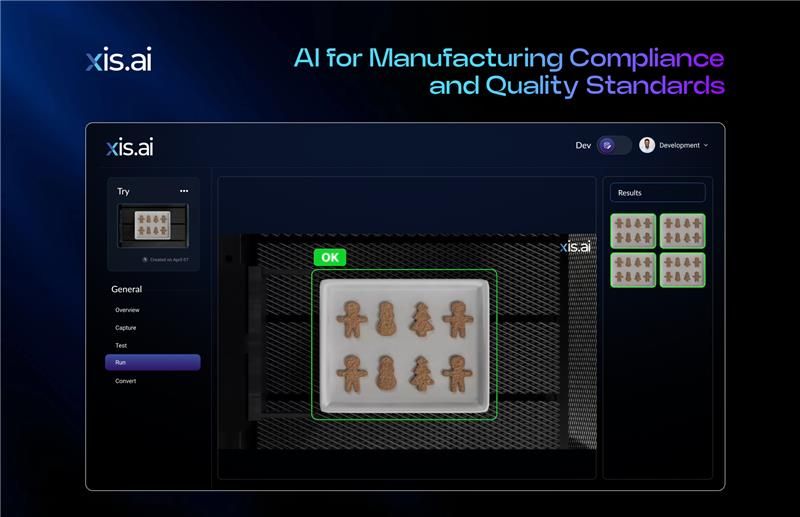
In modern manufacturing environments, platforms like xis.ai help bridge the gap between traditional inspection systems and AI-powered quality intelligence.
Instead of treating inspection as an isolated step, xis.ai integrates AI-driven analysis into broader manufacturing and compliance workflows. This allows manufacturers to connect inspection data, process monitoring, and quality insights within a unified system.
The focus is not only on identifying defects but also on enabling traceable and audit-ready quality decisions that align with international regulatory expectations.
Key benefits of AI in manufacturing quality systems
AI-driven approaches to manufacturing quality standards offer measurable improvements across production environments:
- Improved consistency: Reduces variability in inspection outcomes
- Faster detection: Identifies defects in real time
- Lower compliance risk: Supports continuous alignment with ISO and GMP requirements
- Better traceability: Maintains complete digital records for audits
- Operational efficiency: Reduces dependency on manual inspection
Together, these improvements support more reliable and efficient manufacturing systems.
More detailed challenges and solutions in AI-based inspection systems are explored in this article on AI in Quality Control: Challenges and Solutions, which highlights how manufacturers are overcoming accuracy and scalability issues in real environments.
Challenges in adoption
Despite its advantages, implementing AI in compliance systems comes with challenges.
Manufacturers often face difficulties related to data quality, integration with legacy systems, and regulatory validation. Many existing production environments were not designed for real-time AI processing, which can slow adoption.
Additionally, ensuring trust in AI-driven compliance decisions requires clear validation and transparency, especially in regulated industries.
Future of AI in manufacturing compliance
The future of automated compliance monitoring AI is moving toward fully integrated and adaptive manufacturing environments.
Digital twins, predictive quality systems, and edge AI technologies are enabling manufacturers to simulate, monitor, and adjust production processes in real time.
Over time, compliance will shift from a reactive requirement to a continuously embedded function within manufacturing systems.
Conclusion
Manufacturing quality standards are evolving from static compliance frameworks into intelligent, continuously monitored systems powered by AI. This shift allows manufacturers to improve accuracy, reduce operational risk, and maintain stronger alignment with global regulatory requirements.
By integrating AI-driven inspection and compliance systems, xis.ai is helping manufacturers move toward more transparent, traceable, and efficient quality management—where compliance is not a separate process, but an active part of production itself.
Frequently Asked Questions
1. How does AI improve manufacturing quality standards?
AI improves manufacturing quality standards by enabling real-time defect detection, continuous monitoring, and automated compliance tracking across production lines.
2. What is ISO quality control manufacturing in AI systems?
It refers to using AI to continuously monitor processes and automatically document compliance in line with ISO standards, reducing reliance on manual audits.
3. How does AI support GMP compliance inspection?
AI supports GMP compliance inspection by monitoring environmental conditions, detecting anomalies, and ensuring real-time batch traceability in regulated industries.
4. What is automated compliance monitoring AI?
It is an AI-based system that continuously analyzes production data to ensure processes remain within defined quality and regulatory limits.
5. How does xis.ai help manufacturers with compliance?
xis.ai integrates AI-powered inspection and monitoring into manufacturing workflows, enabling real-time quality tracking and audit-ready compliance reporting.
Comment
0Comments
No comments yet.