AI Food Contamination Detection in Food Production

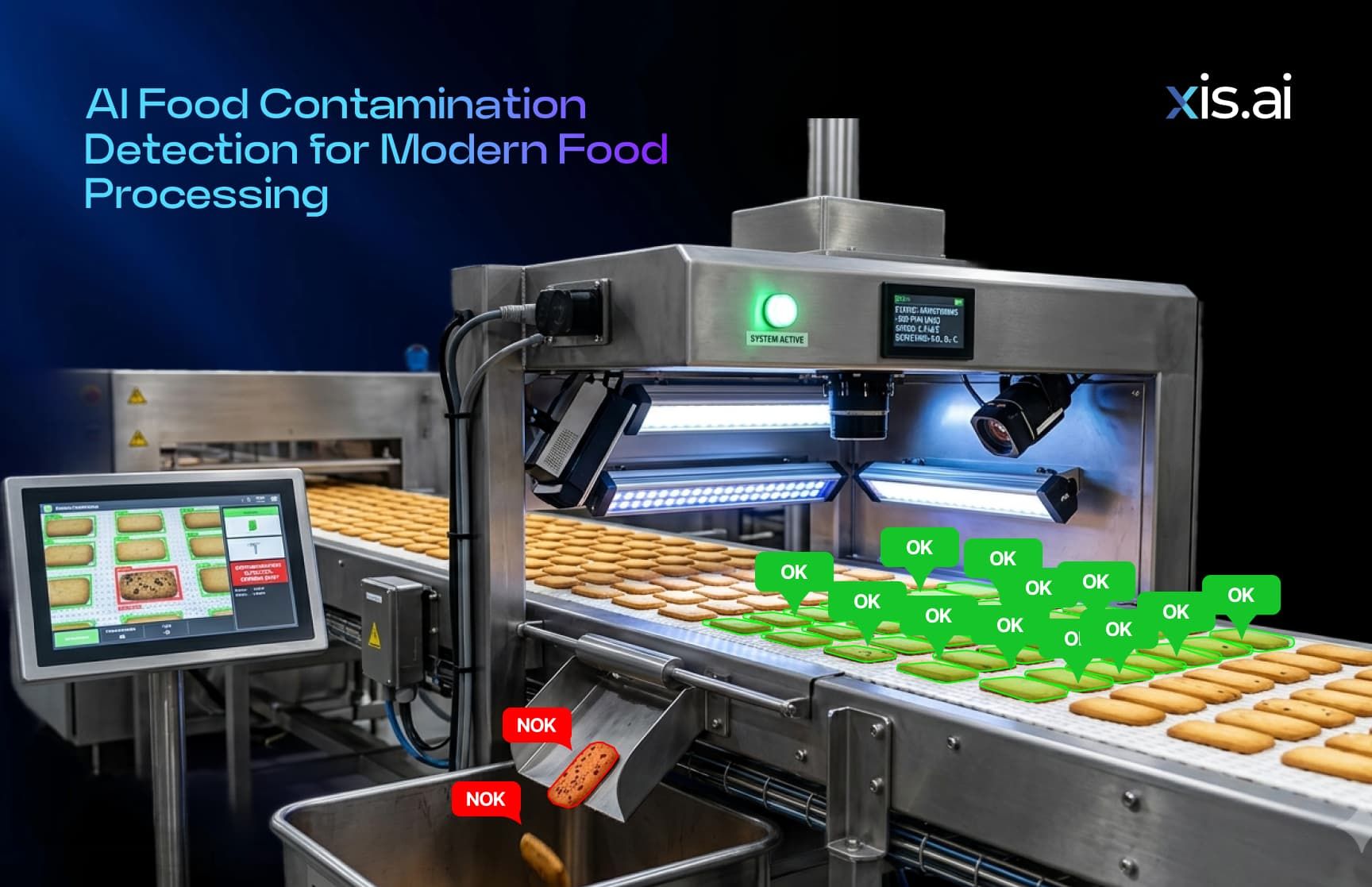
Food safety has become one of the most important priorities in the modern manufacturing industry. As production volumes continue to rise and supply chains become increasingly complex, food manufacturers face constant pressure to maintain strict quality standards while ensuring operational efficiency. A single contamination incident can trigger product recalls, regulatory penalties, customer distrust, and severe financial losses.
For decades, food manufacturers relied heavily on manual inspection processes and conventional machine vision systems to identify contaminants and packaging defects. While these methods offered some level of quality control, they are no longer sufficient for today’s high-speed production environments. Human inspectors can become fatigued, subtle contamination can go unnoticed, and traditional rule-based systems often struggle to adapt to product variability.
This shift in manufacturing complexity is driving the adoption of AI-powered food contamination detection systems across the food industry. Using computer vision and machine learning, these systems help manufacturers inspect products continuously, detect contamination in real time, and improve overall food safety performance without slowing production.
Similar AI-powered inspection technologies are also transforming pharmaceutical manufacturing environments where microscopic defects can directly impact product safety. AI Syringe Defect Detection in Pharmaceutical Manufacturing → explore how AI vision systems improve defect detection in pharmaceutical production lines
Why Food Contamination Remains a Major Challenge
Food contamination can occur at multiple stages of processing and packaging. Raw material handling, automated production lines, sealing processes, transportation systems, and packaging operations all present potential contamination risks.
Even a small foreign particle inside a food product can create serious consequences. Beyond consumer health concerns, contamination incidents can damage brand reputation and disrupt entire supply chains. In highly competitive food markets, maintaining consistent product quality is not only a compliance issue but also a business necessity.
The challenge becomes even greater in facilities operating around the clock. High-speed production lines process thousands of products every hour, making manual inspection increasingly difficult to scale. Inspectors are expected to identify microscopic defects and contamination while products move rapidly across conveyor systems. In these conditions, maintaining consistent accuracy is extremely challenging.
As a result, manufacturers are increasingly turning toward automated food safety inspection systems that can operate continuously with greater precision and consistency.
What Is an AI Food Contamination Detection System?
A modern food contamination detection system uses artificial intelligence, industrial imaging, and deep learning algorithms to inspect food products and packaging automatically during production.
As products move through the manufacturing line, industrial cameras capture high-resolution images from multiple angles. AI models then analyze these images in real time to identify abnormalities, contaminants, and packaging defects.
Unlike traditional machine vision systems that rely on rigid programming rules, AI-based systems learn from large volumes of operational data. This allows them to recognize subtle contamination patterns, adapt to varying product appearances, and improve inspection accuracy over time.
👉 AI-based defect detection is also widely used for identifying microscopic industrial defects in precision manufacturing. How xis.ai Detects Defects in Metal Parts → see how AI identifies subtle structural defects in industrial production systems
This adaptability is especially important in food processing environments where products often vary in shape, color, texture, and packaging style.
The Growing Importance of AI Food Contamination Inspection
The adoption of AI food contamination inspection is growing because manufacturers need inspection systems that can keep pace with modern production demands without sacrificing quality control.
AI-powered inspection systems provide manufacturers with the ability to inspect every product consistently, regardless of production speed or operational complexity. This significantly reduces the likelihood of contaminated products reaching consumers.
One of the most important advantages of AI inspection is its ability to identify subtle contamination that may be difficult for human inspectors to detect consistently. Tiny packaging defects, small foreign particles, surface irregularities, or labeling issues can often be detected more accurately through machine learning models trained on thousands of defect examples.
In addition, AI systems help reduce operational inefficiencies caused by manual inspection bottlenecks. Automated inspection enables food manufacturers to maintain high throughput while improving quality assurance processes simultaneously.
How AI Detects Contamination in Food Processing
AI inspection systems work by combining high-speed imaging technology with advanced deep learning analysis.
As food products move through production conveyors, cameras continuously capture images that are processed instantly by AI models. These models analyze product surfaces, packaging conditions, shapes, textures, and visual consistency to identify abnormalities.
Modern AI systems can detect various contamination risks, including plastic fragments, metal particles, glass contamination, packaging leakage, seal defects, labeling issues, discoloration, and product deformities.
This capability is especially valuable for foreign object detection food industry applications where even extremely small contaminants can create serious food safety concerns.
Unlike traditional inspection systems that often require constant recalibration, AI-powered solutions can adapt to changing production conditions more effectively. This improves reliability in fast-moving and highly variable manufacturing environments.
Why Traditional Inspection Methods Are Becoming Less Effective
Traditional inspection methods continue to create challenges for many food manufacturers. Manual inspection processes are highly dependent on operator concentration and experience, which can vary significantly across shifts and production schedules.
Conventional rule-based machine vision systems also have limitations. These systems typically rely on predefined thresholds and fixed defect parameters, making them less flexible when products or packaging conditions change.
The comparison below highlights why AI-powered inspection is rapidly replacing conventional inspection approaches across food manufacturing facilities.
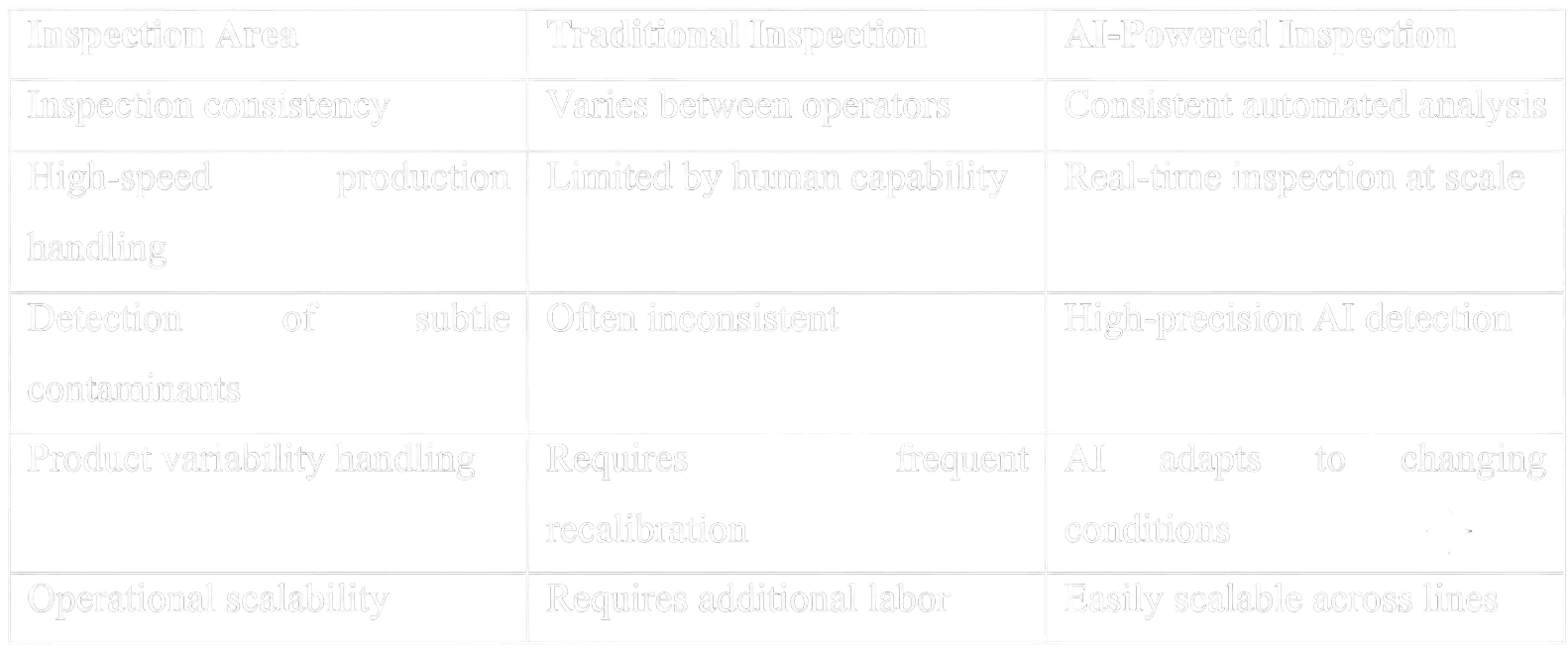
This operational flexibility is one of the primary reasons manufacturers are investing in intelligent inspection automation.
How xis.ai Supports Food Safety Inspection Automation
xis.ai develops AI-powered computer vision solutions that help food manufacturers automate contamination detection and visual inspection processes across production environments.
For food processing operations, xis.ai can support intelligent inspection workflows that improve contamination detection accuracy while integrating seamlessly into existing production infrastructure.
These solutions can help manufacturers implement:
- AI-powered food contamination detection
- Automated food safety inspection systems
- AI food contamination inspection workflows
- Foreign object detection for the food industry
- Real-time visual quality monitoring
- Production-line inspection analytics
By combining scalable machine learning with advanced computer vision technology, xis.ai enables food manufacturers to improve quality assurance, strengthen food safety standards, and reduce operational inefficiencies without disrupting production throughput.
Why AI Inspection Is Becoming Essential for Food Manufacturers
The future of food manufacturing depends heavily on automation, precision, and traceability. As production environments become more complex and regulatory expectations continue to increase, manufacturers require inspection systems capable of delivering reliable performance at scale.
AI-powered inspection systems provide the consistency and adaptability needed to meet these growing demands. They help manufacturers reduce contamination risks, improve operational efficiency, and maintain stronger quality control standards across modern production facilities.
For companies looking to modernize quality assurance processes, investing in intelligent food contamination detection technology is becoming an important step toward building safer, more efficient, and more resilient food manufacturing operations.
Frequently Asked Questions
What Is Food Contamination Detection?
Food contamination detection uses AI vision systems and automated inspection technology to identify contaminants, foreign objects, and product defects during food manufacturing.
How Does AI Food Contamination Inspection Work?
AI food contamination inspection uses machine learning and computer vision to analyze food products and packaging in real time for contamination and quality issues.
What Is A Food Safety Inspection System?
A food safety inspection system is an automated inspection solution that monitors food products and packaging to ensure safety, quality, and compliance standards.
Why Is Foreign Object Detection Important in the Food Industry?
Foreign object detection helps manufacturers prevent contaminated products from reaching consumers while reducing recalls and food safety risks.
What Types of Contaminants Can AI Detect in Food Processing?
AI inspection systems can detect metal fragments, plastic particles, glass contamination, packaging defects, seal failures, discoloration, and labeling issues.
Comment
0Comments
No comments yet.