AI Defect Detection in FMCG: Quality Control Guide

Introduction: Why Manual Quality Control Is No Longer Enough in FMCG
FMCG manufacturing operates under constant pressure: ultra-high production speeds, thin margins, strict regulatory requirements, and near-zero tolerance for quality failures. Whether producing dairy products in cartons, shampoos in plastic bottles, beverages in containers, or packaged consumer goods in pouches and jars, even a small defect can trigger costly recalls, regulatory penalties, and long-term brand damage.
Traditional inspection methods rely heavily on manual sampling, metal detectors, and rule-based vision systems. While effective for basic detection, these approaches struggle to identify hidden defects inside sealed FMCG products like bottles, containers, cartons, and pouches, adapt to frequent SKU changes, and maintain consistent accuracy at modern line speeds.
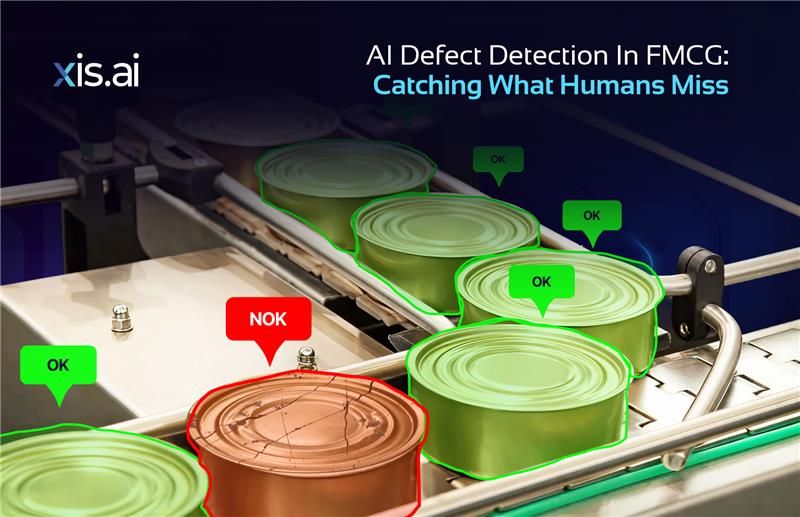
AI defect detection in FMCG manufacturing introduces intelligent inspection systems that analyze X-ray imaging data using deep learning models, enabling factories to detect what human inspectors and conventional systems often miss. By identifying defects earlier and more accurately across FMCG products such as bottles, cartons, pouches, and containers, manufacturers can reduce waste, improve ROI, and continuously enhance production quality.
Understanding AI Defect Detection in FMCG Manufacturing
AI defect detection integrates advanced sensing, intelligent algorithms, and industrial automation to deliver real-time quality decisions for FMCG products like bottles, containers, cartons, jars, and flexible pouches.
Industrial X-Ray Imaging
X-ray inspection enables non-destructive visualization of internal product structures and density variations through opaque packaging materials including plastic bottles, laminated cartons, aluminum pouches, and multi-layer containers. This capability is essential for dairy and liquid products where contaminants, fill inconsistencies, and packaging defects cannot be detected visually.
Machine Learning and Deep Neural Networks
Deep learning models analyze thousands of labeled X-ray images of FMCG products such as shampoo bottles, milk cartons, beverage containers, and sealed pouches. These models learn complex spatial patterns associated with foreign objects, internal voids, misaligned closures, missing components, and density anomalies.
Edge Computing for Real-Time Inspection
Edge-based AI ensures high-speed processing directly on production lines, allowing continuous inspection of bottles, cartons, and containers without introducing latency or throughput limitations.
Common FMCG Defects That Humans Often Miss
Dairy Products (Cartons, Cups, Bottles)
- Metal fragments from processing equipment
- Plastic particles from packaging components
- Underfilled or overfilled milk cartons and bottles
- Seal integrity failures in cups and pouches
- Deformed internal packaging structures
Shampoos and Personal Care (Plastic Bottles, Pumps, Containers)
- Incorrect fill levels inside opaque bottles
- Missing pumps or misaligned caps
- Trapped air pockets affecting net weight
- Bottle deformation after capping
- Internal contamination
Packaged Goods (Pouches, Jars, Boxes, Containers)
- Missing internal components
- Incorrect product placement inside cartons
- Damaged inserts or protective layers
- Density anomalies indicating incomplete assembly
How AI X-Ray Inspection Detects What Humans Cannot
AI-powered X-ray inspection systems evaluate pixel-level density distributions and geometric structures within FMCG products like bottles, containers, cartons, and pouches using:
- Image preprocessing
- Feature extraction
- Deep learning classification
- Automated decision execution
This architecture ensures consistent detection accuracy and traceability at industrial scale.
Key Business Benefits for FMCG Manufacturers
Improved Product Safety and Compliance: Hidden contaminants inside bottles, cartons, and containers are detected early, reducing recall risk.
Reduced Waste and Material Loss: Accurate classification minimizes false rejects and prevents defective bottles, cartons, and pouches from reaching downstream packaging, helping manufacturers significantly reduce waste.
Improved ROI and Production Quality: Lower rework costs, fewer recalls, optimized throughput, and consistent inspection accuracy improve ROI while stabilizing production quality across all FMCG product formats.
Higher Line Efficiency: High-speed inspection keeps pace with bottle filling lines, carton sealing systems, and pouch packaging machines.
Actionable Quality Intelligence: Inspection data provides visibility into defect trends across containers, bottles, and cartons.
Implementation Considerations for FMCG Plants
- Compatibility with various FMCG packaging formats
- Integration with existing automation systems
- Dataset diversity across bottle sizes and container shapes
- Cybersecurity and data governance
- Operator training
The Future of AI Defect Detection in FMCG Manufacturing
AI inspection will enable autonomous quality control across FMCG products like bottles, containers, cartons, pouches, and jars, helping manufacturers further reduce waste, improve ROI, and continuously enhance production quality.
Conclusion
xis.ai provides AI-powered X-ray inspection software for FMCG manufacturers inspecting products such as bottles, cartons, containers, pouches, and jars. Our platform helps organizations reduce waste, improve ROI, and consistently improve production quality through intelligent automation and deep learning analytics.
Frequently Asked Questions
1. What FMCG products can AI defect detection inspect?
AI inspection can analyze bottles, cartons, pouches, jars, containers, cups, and sealed packaging used in dairy, personal care, beverage, and packaged goods manufacturing.
2. How does AI defect detection reduce waste in FMCG manufacturing?
By minimizing false rejects and catching defects early in bottles and containers, manufacturers avoid unnecessary disposal and rework.
3. Can AI inspection improve ROI and production quality?
Yes. Reduced recalls, improved throughput efficiency, consistent inspection accuracy, and lower labor dependency improve ROI and stabilize production quality.
4. Is AI X-ray inspection safe for packaged food and beverages?
Yes. Industrial X-ray systems comply with international safety standards and do not affect product integrity.
5. Can AI systems handle different bottle sizes and packaging formats?
Modern AI models adapt to multiple SKUs, packaging geometries, and container materials with minimal retraining.
6. How fast can AI inspection systems be deployed?
Pilot deployment typically takes weeks, followed by phased scaling.
Comment
0Comments
No comments yet.