Improving Production Efficiency with AI Automation

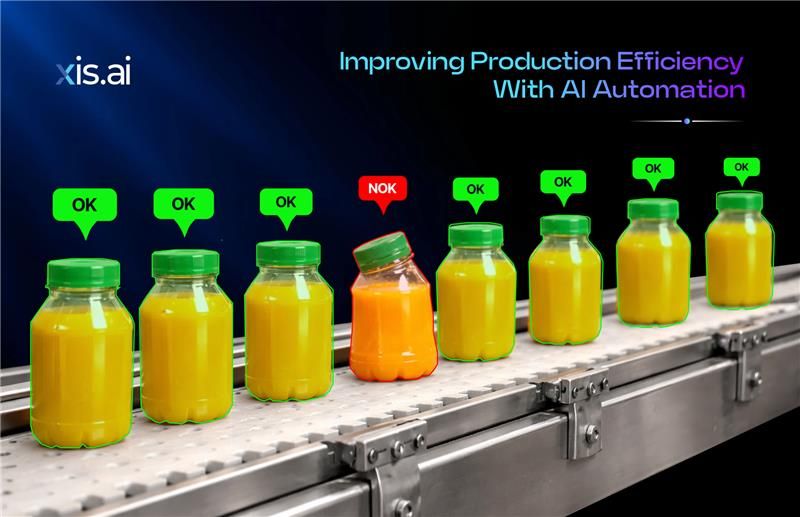
Improving production efficiency with AI automation has become a critical priority for manufacturers facing rising costs, labor shortages, and global competition. Traditional automation helped increase speed and repeatability. AI automation goes further — it introduces intelligence into operations.
Instead of simply executing predefined instructions, AI systems analyze real-time production data, detect inefficiencies, and continuously refine performance. The result is a smarter, more adaptive production environment that improves output while reducing waste.
Why Production Efficiency Still Breaks Down
Even highly automated factories struggle with hidden inefficiencies. These issues often remain invisible until performance metrics decline.
Common challenges include:
- Unplanned downtime caused by undetected machine deviations
- Production bottlenecks between stages
- Delayed quality feedback loops
- Manual data consolidation and reporting
- Underutilized equipment capacity
Individually, these problems may appear minor. Collectively, they significantly increase cost per unit and reduce throughput.
AI automation addresses inefficiency at its root — through continuous visibility and intelligent intervention.
How AI Automation Drives Measurable Efficiency Gains
Improving production efficiency with AI automation requires embedding analytics directly into production workflows. The goal is not just automation, but intelligent automation.
Real-Time Process Monitoring
AI systems continuously collect and analyze data from sensors, machines, and inspection systems.
Instead of reviewing end-of-shift reports, production managers gain live insights into:
- Throughput rates
- Cycle time variation
- Equipment performance
- Micro-stoppages and slowdowns
This enables faster decision-making and prevents minor disruptions from escalating into major losses.
Identifying and Eliminating Bottlenecks
One of AI’s strongest capabilities is pattern recognition. By analyzing workflow data over time, AI identifies recurring constraint points within production lines.
For example, AI may reveal that a specific inspection station consistently slows overall output, or that material handling delays are affecting downstream efficiency.
Rather than making broad operational changes, manufacturers can apply targeted improvements where they matter most.
Smarter Quality Automation
Quality inspection is often a hidden efficiency bottleneck. Manual review slows production and introduces variability.
AI-driven inspection systems improve efficiency by:
- Accelerating defect detection
- Reducing reliance on manual verification
- Standardizing evaluation criteria
- Minimizing rework cycles
This improves both speed and consistency — two essential drivers of production efficiency.
Data & Trend Analytics (DTA) for Enterprise Visibility
Production efficiency cannot improve without clear visibility.
AI platforms use advanced Data & Trend Analytics (DTA) to compile plant-level data into centralized dashboards. Instead of siloed reports, decision-makers see:
- Cross-line efficiency comparisons
- Scrap and yield trends
- Performance deviations
- Capacity utilization patterns
This centralized intelligence transforms raw production data into actionable strategy.
Continuous Learning for Ongoing Optimization
Unlike static automation systems, AI solutions improve over time. As more operational data is processed, analytical models become more accurate.
This continuous learning enables:
- Faster identification of recurring issues
- Improved trend recognition
- Smarter resource allocation
- Progressive refinement of production workflows
Efficiency becomes a moving target — constantly improving rather than plateauing.
Operational and Strategic Benefits
Improving production efficiency with AI automation creates impact at multiple levels of the organization.
On the operational side, manufacturers typically experience:
- Reduced downtime
- Higher equipment utilization
- Faster production cycles
- Lower scrap and rework rates
Strategically, AI automation enables scalability. Organizations can increase output without proportionally increasing labor or infrastructure costs. This strengthens competitiveness and improves long-term profitability.
Overcoming Implementation Concerns
Despite its benefits, many manufacturers hesitate due to integration and cost concerns. Common questions include compatibility with legacy systems, workforce adaptation, and data security.
Modern AI platforms address these challenges through modular deployment and secure integration frameworks. Many organizations begin with a single production line or facility, measure performance improvements, and expand gradually based on measurable ROI.
AI automation is not about replacing existing systems — it is about enhancing them with intelligence.
The Role of xis.ai in Production Efficiency
xis.ai delivers an AI-powered production and quality intelligence layer that enhances operational performance without disrupting plant-level workflows.
Instead of replacing equipment, xis.ai connects to existing systems and provides:
- Real-time production monitoring
- Centralized DTA dashboards
- Anomaly detection for rapid intervention
- Cross-line performance benchmarking
- Continuous analytical learning
By combining automation with intelligent analytics, xis.ai helps manufacturers shift from reactive troubleshooting to proactive optimization.
The result is higher throughput, improved stability, and greater operational transparency.
Industries That Benefit Most
AI-driven efficiency improvements are especially valuable in high-volume and high-precision environments, including:
- Automotive manufacturing
- Electronics and semiconductor production
- EV battery manufacturing
- Aerospace components
- Advanced materials processing
Wherever production generates structured data, AI automation can unlock measurable gains.
Frequently Asked Questions (FAQ)
What is AI automation in manufacturing?
AI automation integrates machine learning and advanced analytics into production systems to improve efficiency, reduce waste, and optimize workflows.
How does AI improve production efficiency?
AI continuously analyzes real-time data, detects inefficiencies early, identifies bottlenecks, and provides actionable insights for optimization.
Can AI automation work with legacy equipment?
Yes. Modern AI platforms integrate through APIs, edge devices, and secure data pipelines without requiring full infrastructure replacement.
How quickly can improvements be measured?
Depending on data readiness, measurable gains in downtime reduction and throughput optimization can often be observed within months.
Is AI automation scalable across multiple plants?
Yes. AI platforms can compile plant-level data into centralized dashboards, enabling enterprise-wide efficiency visibility and benchmarking.
Conclusion
Improving production efficiency with AI automation is not simply about increasing speed. It is about increasing intelligence across the entire production ecosystem.
With real-time monitoring, centralized analytics, and continuous learning, manufacturers gain better control, higher output, and stronger operational resilience.
Platforms like xis.ai provide the intelligence layer that transforms traditional automation into adaptive, high-performance manufacturing systems.
Comment
0Comments
No comments yet.