YOLOv9 vs. YOLOv8: Performance Evaluation

What is YOLO?
Before we move on to the comparison, let’s briefly summarize what YOLO is all about. You Only Look Once (YOLO) is a single-stage object detection architecture that directly predicts bounding boxes and class probabilities from an input image. This approach differs from earlier object detection algorithms that use classifiers for detection. It processes the entire image in a single pass, making it highly efficient for real-time applications.

Fig 1: YOLO Pipeline
Since the first release of YOLO in 2015, several new versions of the same model have been proposed.
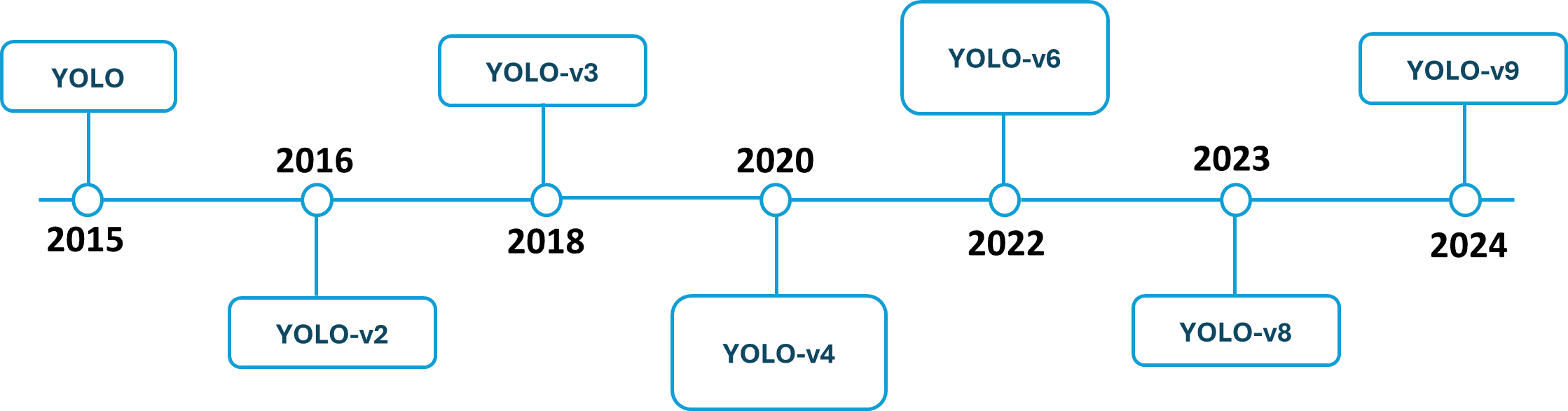
Fig 2: YOLO Timeline
YOLOv8
YOLOv8 was released by Ultralytics in 2022. YOLOv8 builds on the YOLOv5 framework and includes several improvements to both the architecture and the developer experience. YOLOv8 became popular due to its balance between speed and accuracy. It offers faster inference while maintaining real-time performance, making it suitable for applications that require low latency. YOLOv8 detects a higher proportion of true positives while minimizing false positives. Its precision-recall curve demonstrates its superiority in both precision and recall. YOLOv8 also supports fine-tuning on custom datasets. Users can train YOLOv8 to recognize specific object classes relevant to their applications.
Segmentation
YOLOv8 stands out with its ability to perform instance segmentation. While YOLOv9 primarily focuses on object detection, YOLOv8 can also segment objects at the pixel level. This capability is invaluable for tasks such as semantic segmentation and medical imaging.
Pose Estimation
The often-overlooked task of pose estimation is an important aspect of computer vision. YOLOv8 can estimate the orientation or pose of detected objects. It can be used to track yoga poses, analyze sports movements, or enhance augmented reality applications.
YOLO-World
The YOLO-World model introduces a state-of-the-art real-time approach for open-vocabulary detection tasks. This enables the identification of objects in images based on descriptive text prompts. YOLO-World stands out as a versatile tool for various computer vision applications, as it significantly reduces computational costs while delivering competitive performance.
YOLOv9
YOLOv9 builds on the legacy of its predecessors and introduces architectural improvements. Here’s what sets it apart: YOLOv9 incorporates advancements such as Programmable Gradient Information (PGI) and the Generalized Efficient Layer Aggregation Network (GELAN). PGI prevents information loss during gradient updates, while GELAN optimizes lightweight models through gradient path planning.
By integrating PGI with the adaptable GELAN architecture, YOLOv9 not only improves the model’s learning capability but also ensures that important information is preserved throughout the detection process. The advancement of YOLOv9 primarily focuses on addressing the problems caused by information loss in deep neural networks. Its design considers the principle of the information bottleneck and innovatively uses reversible functions to ensure that YOLOv9 maintains both high efficiency and high accuracy.
GELAN(Generalized Efficient Layer Aggregation Network)
YOLOv9 maintains the YOLO family’s reputation for fast processing with a new architecture called GELAN, which combines the best elements of CSPNet and ELAN. CSPNet excels at managing data flow to efficiently extract important features, while ELAN focuses on fast processing through stacked layers. GELAN combines these characteristics, providing a design that is not only lightweight and fast but also accurate.
It improves upon ELAN by stacking not only layers but also different types of processing blocks, which enhances the model’s speed and efficiency across all its components.
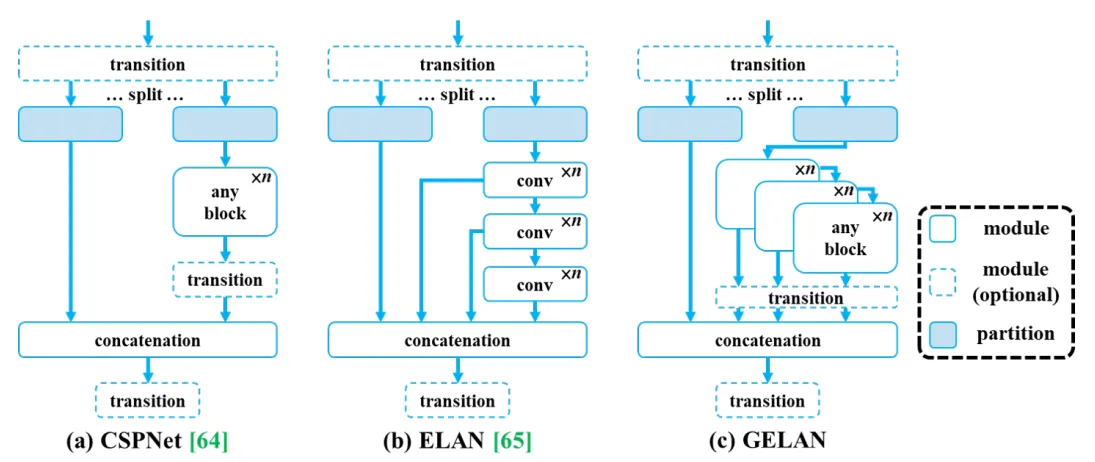
Fig 3. Gelan Architecture
PGI (Programmable Gradient Information)
YOLOv9 addresses a common problem in deep learning known as the “information bottleneck.” This occurs when important details are lost as data moves through the many layers of a neural network, which can lead to errors in what the network learns or predicts. To address this issue, YOLOv9 introduces an intelligent tool called Programmable Gradient Information (PGI).
Imagine the neural network as a long pipe through which information flows. Sometimes, important details can slip through the cracks. PGI acts like a special pathway within this pipe, ensuring that the truly important information is not lost. To achieve this, an auxiliary pathway—similar to a memory pathway—is created alongside the main pathway. This auxiliary pathway helps the network retain and use important details, allowing it to learn more effectively and make more accurate predictions about what it sees, such as identifying objects in a photograph.
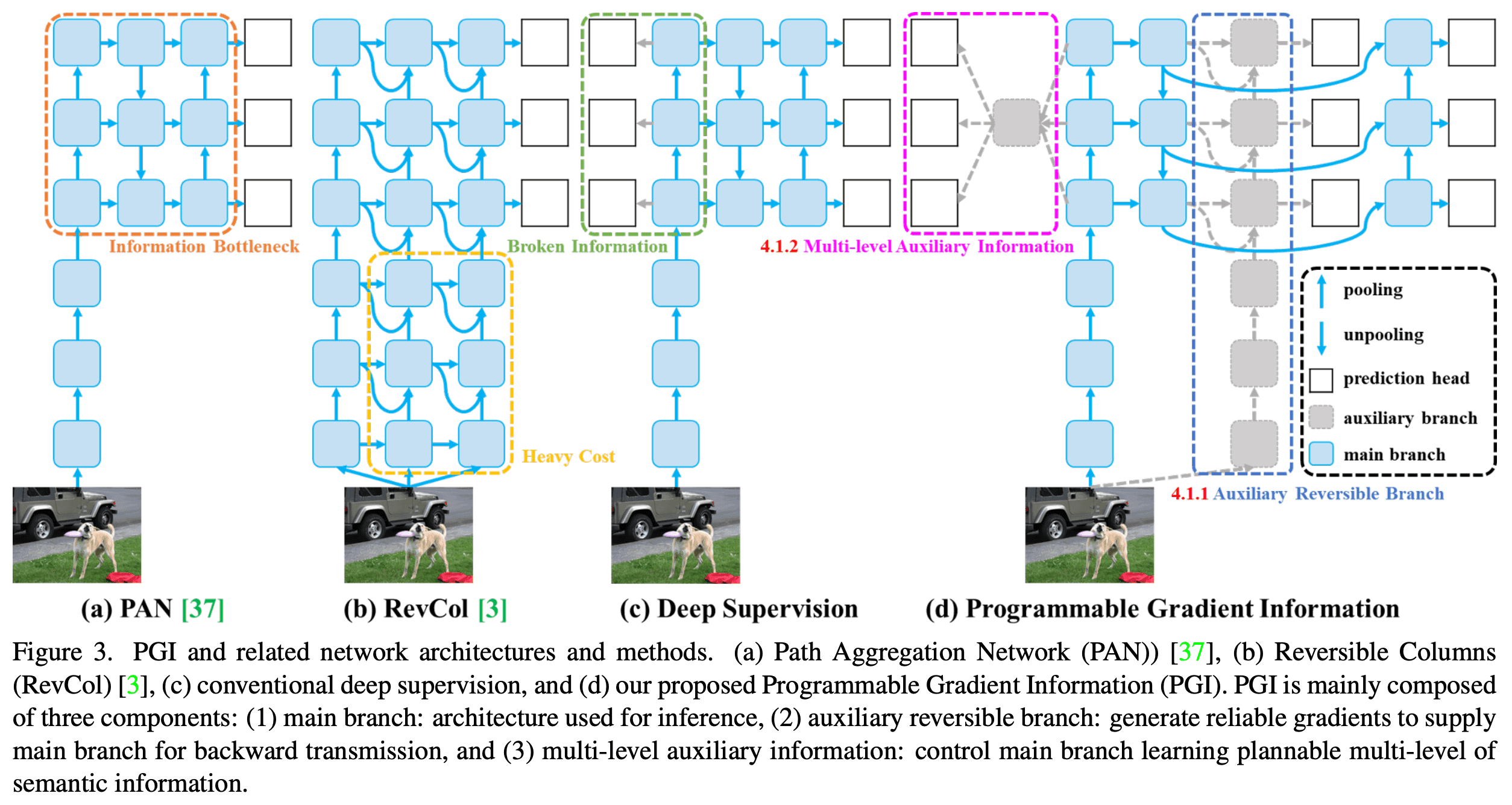
Fig 4. PGI Architecture
Comparative Analysis
The performance of YOLOv9 on the COCO dataset demonstrates significant advances in object detection, offering a balanced combination of efficiency and accuracy across different versions. With improved accuracy and reduced computational requirements, YOLOv9 continues to build upon the standards established by earlier versions of the YOLO series.
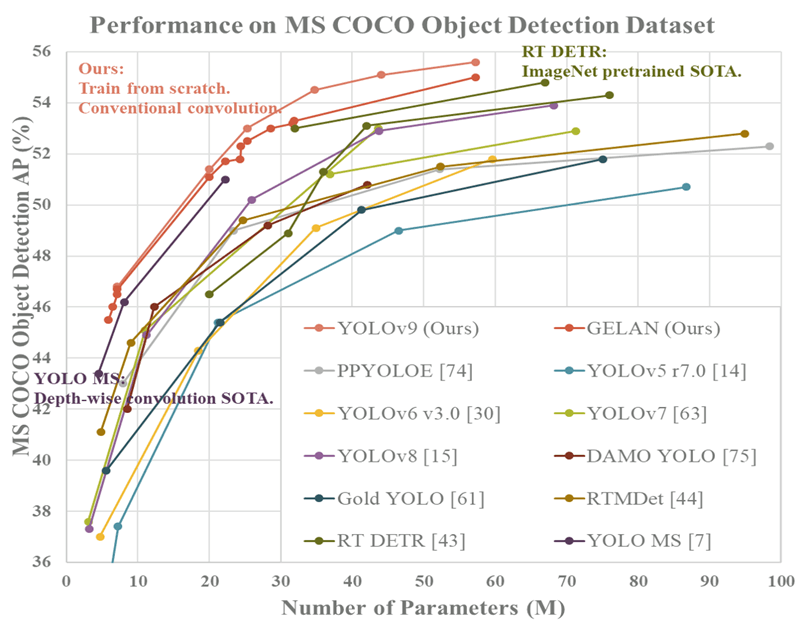
Fig 5. YOLOv9 performance on coco datasets
YOLOv9 outperforms YOLOv8 in terms of accuracy. The YOLOv9e model sets a new standard for large models, with 15% fewer parameters and 25% lower computational requirements than YOLOv8x, while achieving a further 1.7% improvement in AP.
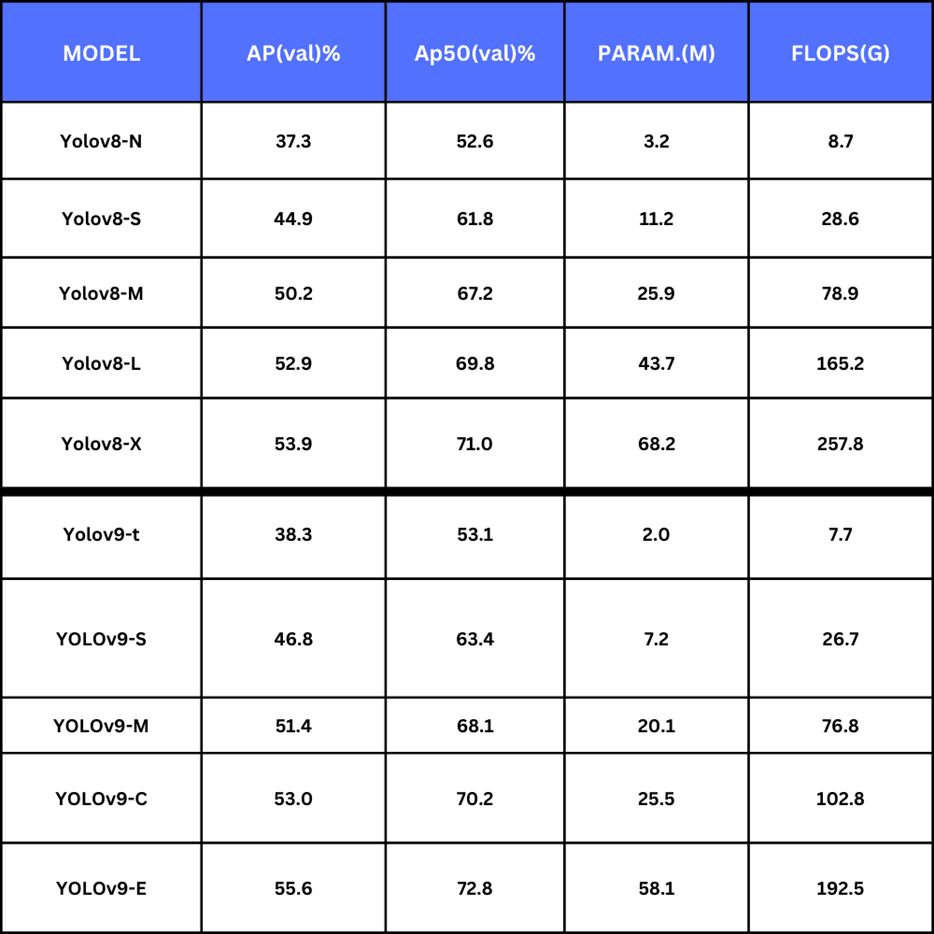
YOLOv9: Key Findings
YOLO models have become a benchmark for object detection due to their exceptional performance and versatility. Here are our initial findings on YOLOv9:
- YOLOv9 Usability: YOLOv9 is available on GitHub and can be quickly implemented through the Command-Line Interface (CLI) or an Integrated Development Environment (IDE) in Python.
- YOLOv9 Tasks: YOLOv9 demonstrates strong efficiency in real-time object detection, offering improved accuracy and speed.
- YOLOv9 Improvements: Key improvements in YOLOv9 include a decoupled head with anchor-free detection and Mosaic data augmentation, which is disabled during the final ten training epochs.
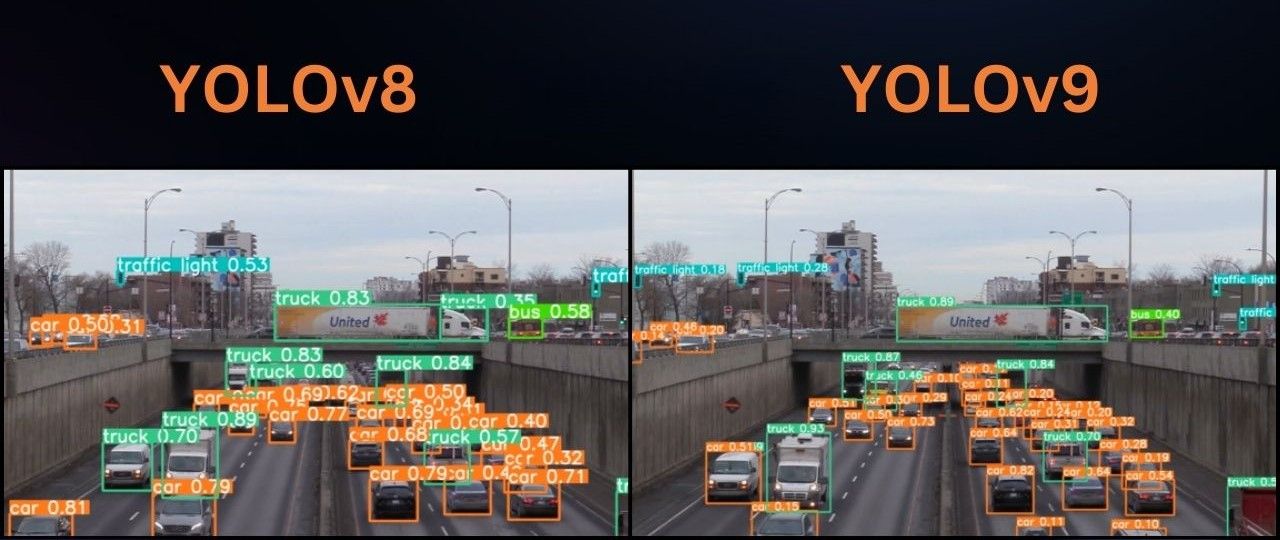
The experiments conducted show that YOLOv9 performs better than YOLOv8 when detecting smaller objects and objects that are farther away from the camera, as demonstrated by the well-known traffic light detection video. Conversely, YOLOv8 demonstrates an advantage in detecting objects at close range and handling false detections.
Interestingly, despite having a larger number of parameters, YOLOv8 delivers significantly faster performance than the ready-to-use PyTorch models. However, further testing with frameworks such as ONNX/TensorRT is warranted to fully evaluate performance.
Interestingly, despite having a larger number of parameters, YOLOv8 delivers significantly faster performance than the ready-to-use PyTorch models. However, further testing with frameworks such as ONNX/TensorRT is warranted to fully evaluate performance.
Literature Reference
Chien-Yao Wang, I-Hau Yeh.
„Liaohttps://arxiv.org/pdf/2402.13616.pdf“(2024)
Comment
0Comments
No comments yet.