Reducing Rework and Scrap With Real-Time AI: USA and Germany

Why Rework and Scrap Remain Persistent Manufacturing Challenges
Rework and scrap continue to be among the largest hidden cost drivers in modern manufacturing. Defective parts that require reprocessing consume additional labor, machine time, energy, and materials, while scrapped components represent direct financial loss and reduced production capacity. In high-throughput environments, even small defect rates can escalate into substantial operational inefficiencies and missed delivery targets.
Traditional quality control approaches rely on periodic sampling, manual inspection, and rule-based machine vision systems. These methods often struggle to maintain accuracy as product complexity increases, tolerances tighten, and production speeds accelerate. Many defects are detected only after downstream processing, assembly, or final inspection, significantly increasing the cost of correction.
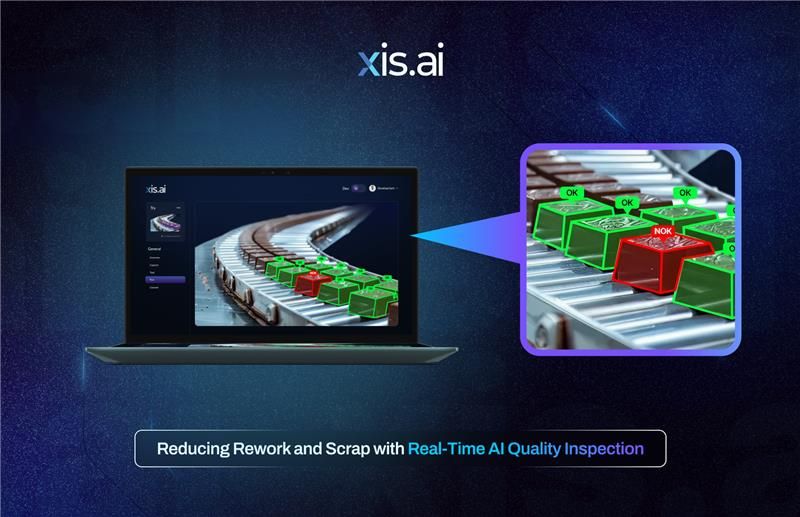
Real-time AI quality inspection enables manufacturers to detect defects immediately as parts are produced, allowing corrective action before value is added. This proactive approach reduces rework, minimizes scrap, improves ROI, and stabilizes production quality across complex manufacturing environments.
How Real-Time AI Quality Inspection Works
Real-time AI quality inspection combines advanced sensors, machine learning algorithms, and edge computing to continuously analyze production output. Imaging technologies such as industrial vision systems, X-ray inspection, laser profiling, and thermal sensors capture high-resolution data from every part moving through the line.
Deep learning models process this data to identify anomalies, dimensional deviations, surface defects, internal structural inconsistencies, and assembly errors. Unlike traditional rule-based inspection systems that depend on static thresholds, AI models learn from historical production data and adapt to natural process variation while maintaining sensitivity to true defects.
Edge computing ensures that inference occurs locally within milliseconds, enabling immediate pass-or-fail decisions without network latency. This supports uninterrupted production even in high-speed or mission-critical manufacturing operations.
Typical inspection workflows include:
• Real-time image acquisition from industrial cameras on live production lines
• AI-based feature detection and defect identification
• Inline inspection without slowing down production speed
• Automated rejection, alerting, and traceability logging
Why Early Detection Significantly Reduces Rework and Scrap
Rework and scrap increase when defects propagate downstream before being detected. A part that passes early inspection but fails later may already have consumed additional machining time, coatings, assembly labor, or expensive subcomponents. Real-time inspection detects defects immediately after each critical process step, preventing unnecessary value addition to nonconforming parts.
AI systems also reduce false rejects by learning acceptable process variation rather than relying on rigid thresholds. This stabilizes yield and prevents unnecessary disposal of conforming products. Continuous inspection data provides immediate feedback to operators and automation systems, allowing rapid parameter adjustments and process stabilization.
Early detection delivers measurable operational advantages:
• Reduced downstream reprocessing and material loss
• Faster containment of process drift and equipment issues
• Improved first-pass yield and throughput stability
• Lower quality-related downtime
Applications Across Industrial Manufacturing Environments
Real-time AI inspection is widely adopted across industries where precision, reliability, and scalability are critical. In machining and metal fabrication, AI detects dimensional deviations, tool wear patterns, surface defects, and micro-cracks. In electronics manufacturing, it identifies solder defects, misalignment, component damage, and voids within assemblies. In automotive and aerospace production, AI supports inspection of weld integrity, composite structures, castings, and safety-critical assemblies.
Across all these environments, real-time inspection enables consistent quality enforcement at speeds that manual inspection cannot sustain.
Business Impact: From Cost Control to Competitive Advantage
Reducing rework and scrap directly improves material utilization, machine availability, and labor efficiency. Automated inspection reduces dependency on manual quality checks, improving consistency and scalability. Stable inspection accuracy prevents unnecessary production interruptions caused by excessive rejects or quality disputes.
Business outcomes typically include:
• Lower operational costs and waste
• Higher equipment utilization and throughput reliability
• Improved delivery performance and customer satisfaction
• Stronger ROI and production quality consistency
• Enhanced sustainability through reduced resource consumption
Implementation Considerations for Manufacturers
Successful implementation requires alignment between inspection performance and production requirements. Sensor selection must match defect characteristics and environmental conditions. Data quality and labeling strategy directly influence model accuracy. Integration with PLCs, MES platforms, and quality management systems ensures traceability and closed-loop control.
Important considerations include:
• Latency requirements and edge computing capacity
• Cybersecurity and system resilience
• Model governance and validation processes
• Workforce training and change management
A phased deployment strategy allows performance validation before enterprise-wide rollout.
The Future of Real-Time AI Quality Inspection
As manufacturing systems become more connected and autonomous, real-time AI inspection will evolve toward predictive quality intelligence, self-optimizing processes, and closed-loop automation. AI models will increasingly anticipate defects before they occur by correlating inspection data with process parameters, environmental conditions, and equipment health indicators.
Manufacturers that invest in intelligent inspection today will gain long-term advantages in cost efficiency, operational resilience, regulatory compliance, and product reliability.
Conclusion:
Reducing rework and scrap requires more than incremental process adjustments — it demands real-time visibility, intelligent decision-making, and rapid corrective action. Real-time AI quality inspection empowers manufacturers to detect defects at the earliest possible stage, prevent downstream waste, and maintain stable production quality at scale.
By replacing reactive inspection models with adaptive, data-driven intelligence, organizations can achieve higher yield, improved ROI, stronger operational control, and sustainable manufacturing performance. As competition intensifies and product complexity increases, intelligent quality inspection will become a foundational pillar of next-generation manufacturing excellence.
Frequently Asked Questions
1. What is real-time AI quality inspection?
Real-time AI quality inspection uses machine learning algorithms and industrial sensors to automatically detect defects as parts are produced, enabling immediate corrective action.
2. How does AI inspection reduce rework and scrap?
By identifying defects immediately after production steps, defective parts are removed before additional processing occurs, preventing unnecessary rework and material waste.
3. Which industries benefit most from real-time AI inspection?
Automotive, aerospace, electronics, metal fabrication, medical devices, and advanced manufacturing benefit significantly due to high precision and quality requirements.
4. Does AI inspection improve ROI and production quality?
Yes. Reduced waste, improved yield, lower labor dependency, and stable inspection accuracy directly improve ROI and production quality.
5. How accurate are AI-based inspection systems compared to traditional methods?
AI systems consistently outperform rule-based inspection by adapting to process variability and maintaining high sensitivity to true defects.
6. How long does implementation typically take?
Pilot deployments usually take several weeks depending on system complexity and integration requirements.
Comment
0Comments
No comments yet.