AI Tire Surface Defect Inspection for Auto Quality

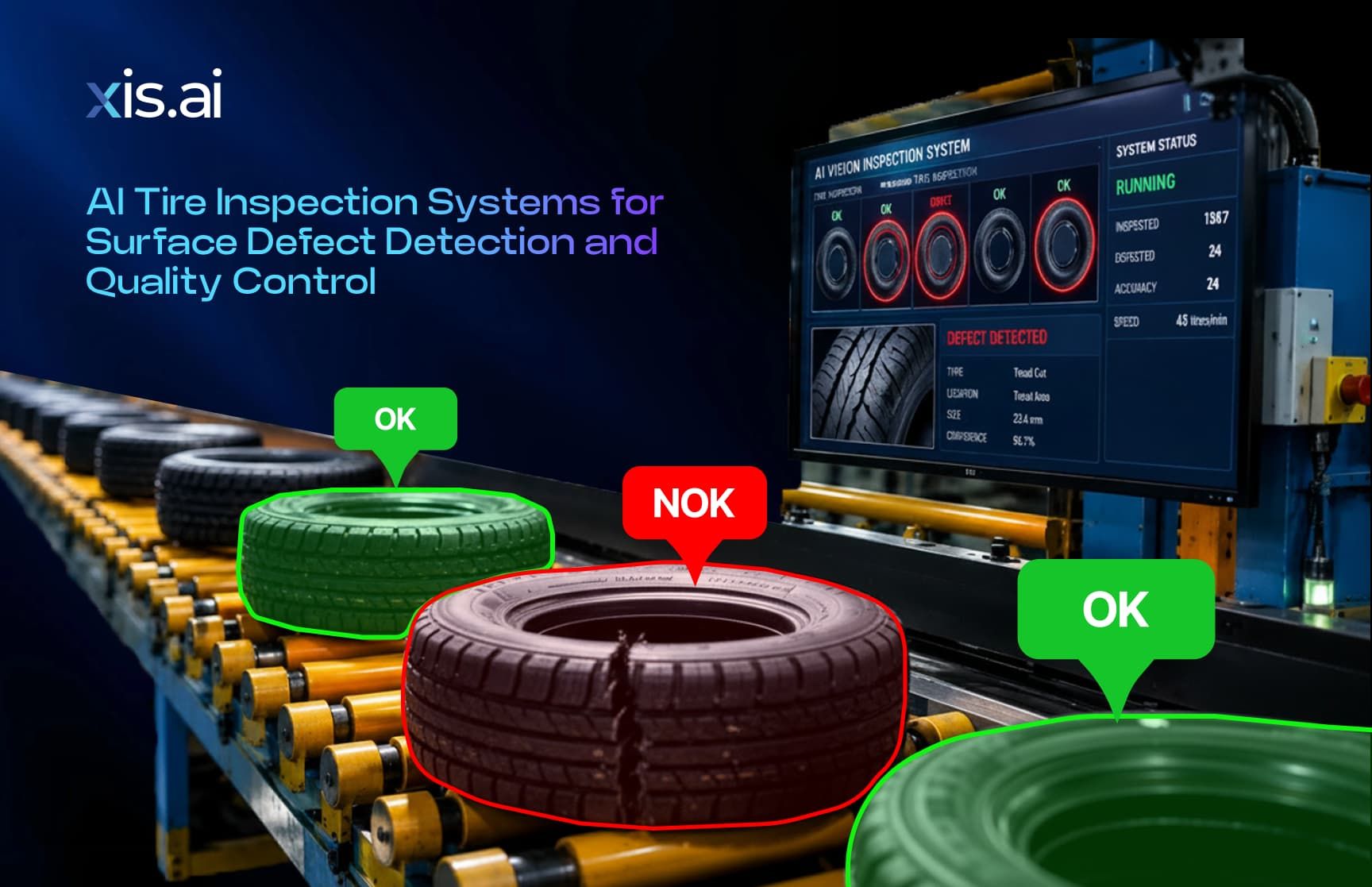
The life of a tire does not begin when it is fitted to a car; it starts much earlier than that.
Before it goes on to be attached to a vehicle, a tire undergoes several manufacturing processes that include rubber mixing, parts assembly, molding, curing, finishing, and inspecting, and by the end of these processes, hundreds of factors could influence the quality of the final product.
In most cases, the tires will come out from the factory exactly the way they were supposed to be manufactured. But not all of them do; It could be anything—a defect in the sidewall of the tire, an issue in the tread of the tire, an air bubble that forms, or a defect on its surface, among others.
On their own, these flaws may appear inconsequential. However, manufacturers are aware that such small defects identified later in the process of manufacture or even after delivery can pose some risks for them.
Where Tire Manufacturing Defects and Surface Imperfections Usually Begin
Manufacturing defects are often associated with visible or catastrophic failures, but in most cases, the problem begins much earlier and far more subtly.
Most defects of tires begin as minor anomalies which occur at some point during production. They may happen while the rubber is being prepared, cured, trimmed, or finished.
Common examples include:
- Sidewall cracks
- Surface cuts
- Air bubbles and blisters
- Tread inconsistencies
- Material contamination
- Mold-related imperfections
- Flashing defects
- Surface texture abnormalities
The challenge is not that these defects are impossible to find. The challenge is finding them consistently among thousands of tires moving through production every day.
Why Manual Tire Inspection Creates Quality Control Challenges
Human inspection has been a fundamental part of tire quality control for years, and experienced inspectors continue to play an important role in maintaining manufacturing standards.
But production environments are no longer the same. Manufacturers are producing at higher volumes, tire designs are becoming more advanced, and quality expectations continue to increase. At the same time, defects have become smaller, more complex, and far more difficult to detect consistently.
As a result, inspectors often need to assess hundreds or thousands of tires within a single shift.
Even highly skilled professionals can face challenges such as:
- Inspection fatigue
- Lighting variations
- Surface reflections
- Product variation
- Time constraints
How AI Tire Inspection Systems Analyze the Final Quality Inspection Stage
Advanced imaging technology enables capturing high resolution images of tire surfaces from various angles. Each sidewall, tread, and important area is captured for analysis purposes.
Instead of only asking:
- "Do I see an acceptable tire?"
AI technology is now able to ask:
- "Is there anything about this tire that is not seen in thousands of other acceptable tires?"
That changes the very approach to quality control entirely.
While quality control used to involve strict adherence to defect criteria, now AI is analyzing visual data and potential patterns and abnormalities. Every image produced during tire inspection contributes to the overall analysis of the production process.
After some time, it allows to answer questions like:
- "What defects do we see more often today?"
- "Is any particular line producing more defects?"
- "Is there a problem with a specific mold?"
- "Does material play a role in creating quality defects?"
And so forth. This transforms inspection from a quality gate into a continuous source of operational insight.
How the Tire Manufacturing Industry Is Adopting AI Inspection Technology
However, AI-enabled inspection systems are now already a reality. Tire manufacturers that are among industry leaders have been implementing intelligent inspection systems to reinforce the quality control system and increase the precision of defect detection.
For instance, Nexen Tire has already announced the implementation of an AI-enabled inspection system to increase the company's ability to detect defects in its products and to maintain the level of quality through consistent inspection.
There is an obvious reason behind this decision. With increased complexity of tire design and automation in production, manufacturers need a new type of inspection systems that will be able to cope with increasing complexity and guarantee a consistently high quality of production.
One of the difficulties associated with inspecting tires is related to their shape and texture. In contrast to flat elements, tires are usually curved, have a complicated tread pattern, and differ in material structure. Therefore, the same defect in two different tires may look very different.
This is one of the limitations of classical rule-based inspection systems. Modern AI systems solve this issue with the help of machine learning algorithms for analyzing visual patterns.
This enables manufacturers to identify:
- Surface cracks
- Blisters
- Contamination
- Tread irregularities
- Sidewall anomalies
- Rubber defects
Manufacturers are no longer just aiming for quicker defect detection but are now looking towards avoiding defects before they happen altogether. Through the use of AI-enabled visual inspection coupled with production analysis, they are able to determine what is causing the quality variability, be it the wear and tear of the mold or problems with the process itself or even the material handling processes. This makes inspection not only a means of checking but also a basis for decision making.
The Future of AI Tire Quality Inspection and Manufacturing Automation
Every tire carries a manufacturer's reputation with it. Long before customers evaluate comfort, handling, or durability, manufacturers must ensure that each tire leaving the factory meets quality expectations.
AI-powered inspection systems are helping achieve that goal by providing a more consistent, scalable, and data-driven approach to quality assurance.
As production complexity continues to increase, the future of automotive tire quality inspection will be defined not only by the ability to identify defects but by the ability to understand and prevent them.
Organizations evaluating next-generation inspection technologies can explore how computer vision is transforming industrial quality control or request a personalized consultation with xis.ai to assess potential applications within tire manufacturing environments.
Frequently Asked Questions
What is a tire inspection system?
A tire inspection system uses cameras, sensors, and AI software to identify manufacturing defects and surface anomalies before tires leave production facilities.
How does rubber inspection AI work?
Rubber inspection AI analyzes production images and learns visual patterns associated with acceptable products and defects, allowing it to identify anomalies automatically.
Can AI inspection systems be integrated into existing tire production lines?
Yes. Modern AI vision systems can often be integrated alongside existing inspection equipment and manufacturing workflows with minimal disruption.
Comment
0Comments
No comments yet.