AI-Powered Snack Packaging Inspection for Food Quality Assurance

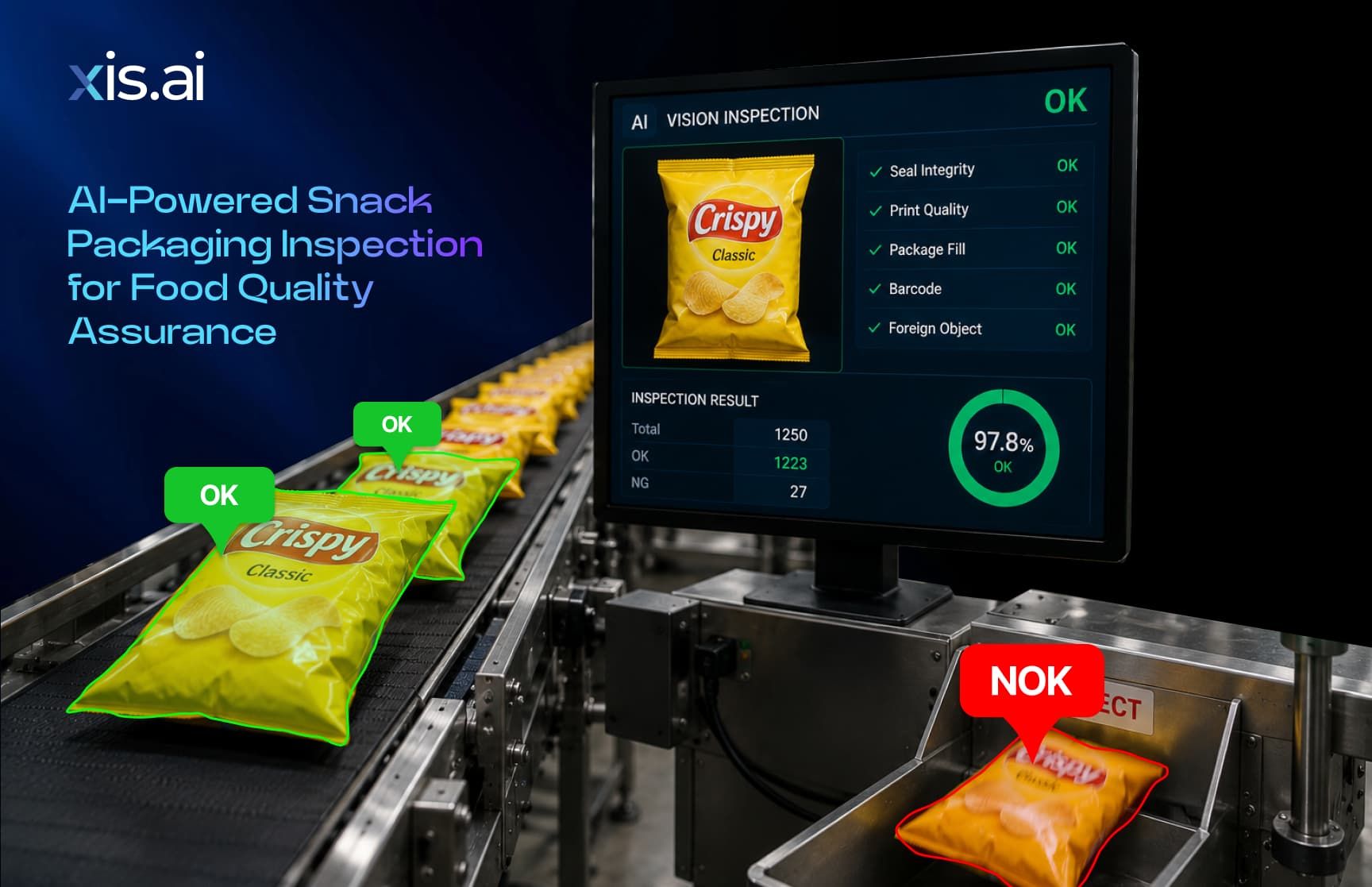
In snack manufacturing, quality depends on both the product and its packaging. Even with perfect formulation and safety, poor packaging can undermine customer satisfaction.
Consumers expect snacks to be fresh, well-sealed, and visually consistent. Packaging quality directly shapes perception; damaged or incorrectly labelled packages hurt confidence before tasting.
With fast production, ensuring consistent packaging is challenging. AI-powered inspection is becoming vital in modern food manufacturing.
Role of Packaging in Snack Product Quality Assurance
Food manufacturers invest in ingredients, process control, and safety, but ultimately, packaging serves as the final line of defence between the product and external factors.
Packaging serves several essential functions:
- Preserving freshness
- Protecting against contamination
- Preventing moisture ingress
- Supporting shelf-life requirements
- Communicating product information
- Maintaining brand presentation
When packaging fails, product quality suffers, regardless of the standards met earlier in the manufacturing process. This connection underscores the packaging's significance.
This connection is particularly significant in snack production, where freshness and texture are key drivers of customer satisfaction.
However, not every packaging defect is immediately visible.
Minor defects, such as slight seal issues or poor labelling, may seem insignificant during production but often lead to downstream issues for retailers, distributors, and consumers.
Common packaging-related issues include:
- Incomplete seals
- Packaging film wrinkles
- Label placement errors
- Missing or incorrect date codes
- Damaged packaging materials
- Print quality inconsistencies
- Product contamination within sealed areas
Even if each defect affects few products, recurring issues increase waste, trigger customer complaints, and drive up quality control costs.
The Challenge of Inspecting High-Speed Snack Production Lines
Modern snack production facilities are designed for efficiency.
Packaging lines often process thousands of products per hour across multiple product formats, packaging materials, and SKU variations.
In these fast-paced environments, relying on manual inspection alone is often impractical as production scales up.
Quality teams must ensure that every package meets standards for:
- Seal integrity
- Label accuracy
- Packaging appearance
- Coding compliance
- Product positioning
As production speeds rise and portfolios expand, maintaining consistent inspection performance becomes increasingly challenging, necessitating new solutions.
Traditional machine vision systems use defined rules for inspection. While effective, they require frequent adjustments as packaging designs, materials, or production conditions shift.
AI introduces a more adaptive approach.
Food package defect detection systems use computer vision and machine learning to analyse images captured during production and identify patterns associated with packaging defects.
These systems can support the detection of:
- Seal defects
- Wrinkled packaging films
- Missing labels
- Print and coding errors
- Packaging contamination
- Product positioning issues
- Damaged packaging materials
Because inspections happen in real time, manufacturers identify quality concerns before products move further through the supply chain.
Why Packaging Seal Inspection Remains a Priority
Among all packaging quality attributes, seal integrity remains one of the most critical.
A package may appear visually acceptable yet contain a seal defect that can affect product freshness and shelf life.
For this reason, many food manufacturers implement dedicated packaging seal inspection systems as part of their broader quality assurance programs.
AI-powered seal inspection solutions can help identify subtle variations that may indicate:
- Incomplete sealing
- Weak seals
- Seal contamination
- Material misalignment
- Seal-area defects
This extra verification step helps manufacturers maintain product quality and reduces the risk of defective products reaching retailers or consumers.
One of the advantages of AI inspection is that it generates information beyond simple pass-or-fail decisions.
Inspection data reveals recurring patterns that help manufacturers improve production processes.
For example:
- Frequent seal defects may indicate equipment wear.
- Repeated labelling issues may suggest calibration problems.
- Consistent packaging anomalies may reveal material-handling challenges.
This approach transforms inspection from a quality-control activity into a source of operational intelligence that supports continuous improvement.
How xis.ai Supports Snack Packaging Inspection
xis.ai provides AI-powered computer vision solutions designed to help food manufacturers strengthen packaging quality assurance across production environments.
Inspection capabilities can support:
- Snack packaging inspection
- Food package defect detection
- Packaging seal verification
- Label inspection
- Coding verification
- Production-line monitoring
Manufacturers who implement AI-powered visual inspection systems improve inspection consistency and reduce dependence on manual quality checks.
Conclusion
Packaging quality plays a critical role in protecting food products throughout storage, transportation, and retail distribution. As production volumes continue to increase and quality expectations become more demanding, manufacturers require inspection systems capable of delivering reliable and scalable performance.
AI-powered snack packaging inspection is vital for identifying packaging defects, improving seal verification, and strengthening quality assurance processes in food manufacturing. This technology ensures that the main objective, consistent product quality from production to consumer, is achieved.
For food manufacturers seeking to protect product freshness, reduce waste, and maintain consumer confidence, intelligent packaging inspection is becoming an increasingly valuable component of modern food production.
Frequently Asked Questions
Why is packaging seal inspection important in snack manufacturing?
Seal inspection helps ensure product freshness, prevent contamination, and maintain shelf-life requirements.
What defects can snack quality inspection AI detect?
AI can identify seal defects, packaging damage, labelling errors, coding issues, contamination, and other packaging-related quality concerns.
Can AI inspection systems be integrated into existing food production lines?
Yes. AI-powered inspection solutions can typically be integrated into existing packaging and production workflows with minimal disruption.
Comment
0Comments
No comments yet.