AI SMT Inspection for Electronics Quality Controls

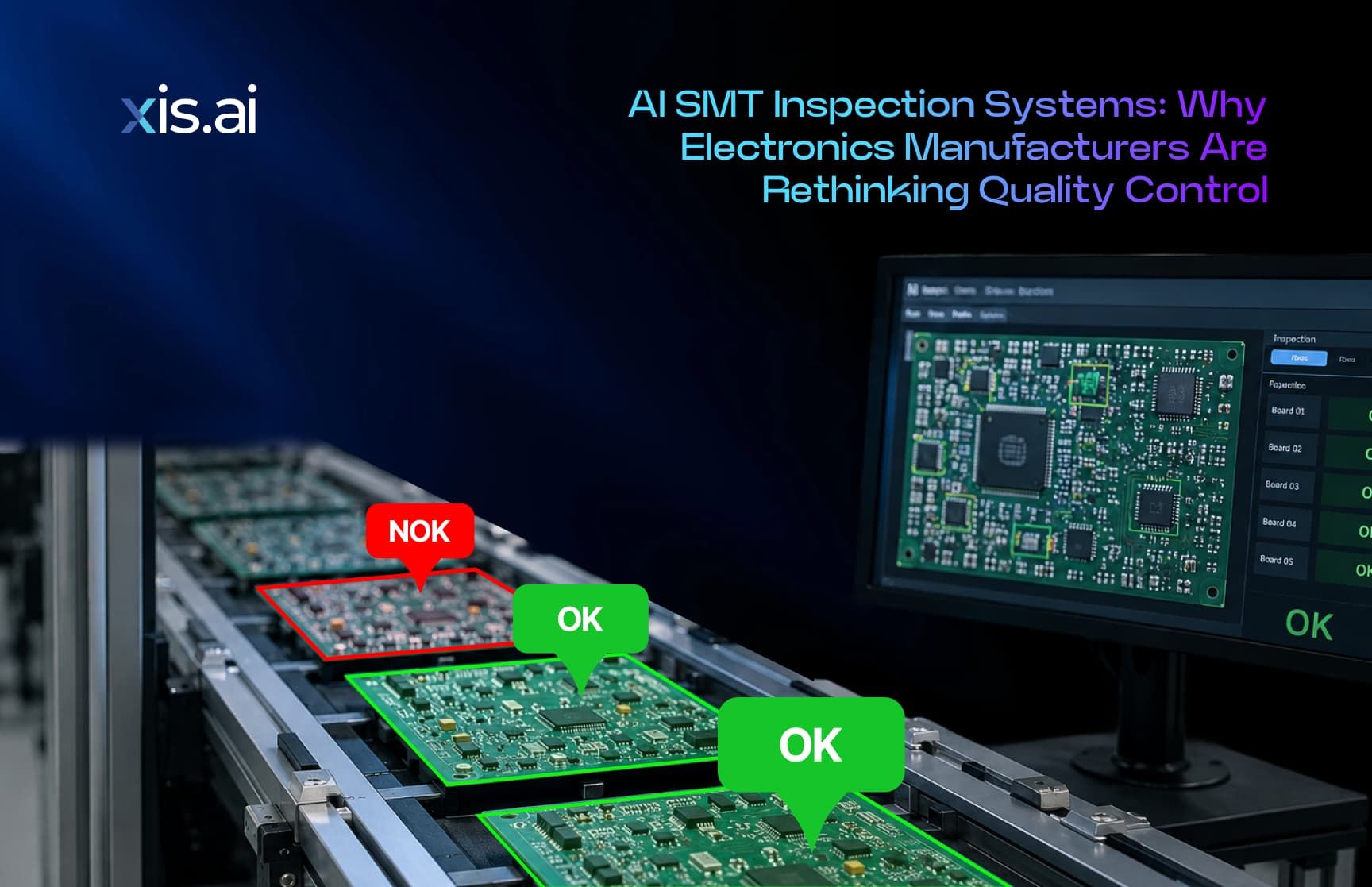
A resistor the size of a pinhead can render an entire electronic assembly completely non-functional.
In SMT production lines, such problems are generated in a matter of seconds. This could be a slight offset of the component, wrong formation of the solder joint, or even incorrect orientation of polarity-specific elements. On their own, such problems might not look threatening. However, collectively, they can cause expensive repair work, delays, field malfunctions, and unhappy customers.
This issue becomes even more challenging due to miniaturization. Today’s PCBs in smartphones, automotive systems, industrial automation tools, and healthcare equipment feature several hundred or even thousand elements in a compact size.
The problem for quality professionals is not if, but how inspection can match current manufacturing trends.
The Problem Isn't Production Speed—It's Visibility
Electronic firms have been striving for years to enhance the manufacturing process.
Pick-and-place equipment is able to place thousands of components per hour. Reflow ovens provide highly accurate conditions for soldering. Assembly lines work with an incredible accuracy.
However, inspection is one of the most complicated stages.
Thousands of boards can be produced in one production shift. Nevertheless, quality specialists must feel assured that all components are assembled, properly placed, and soldered.
The challenge consists in the ability to see.
Many SMT defects are very tiny, and it is hard to detect them. Moreover, when there are smaller components and dense PCB layouts, even high-tech AOI devices may experience some difficulties.
Why SMT Defects Are Becoming Harder to Detect
The electronics industry is moving toward higher-density designs, more compact products, and greater functionality.
This evolution creates new inspection challenges.
Common SMT defects include:
- Missing components
- Tombstoning
- Solder bridges
- Lifted leads
- Component rotation errors
- Insufficient solder joints
- Incorrect polarity placement
- Foreign material contamination
The problem is not simply identifying these defects.
The difficulty lies in detecting such patterns consistently in different products, circuits, lighting situations, and production settings.
What seems clearly visible as a flaw in one circuit board will seem entirely different in another circuit board.
It is in such situations that the usual approach of using inspection rules becomes very challenging.
What AI Sees That Traditional Systems Often Miss
Traditional inspection systems operate based on pre-set rules. For instance, such systems can check if a certain part fits inside a defined positional tolerance or a solder joint adheres to a certain shape rule. This is effective, but modern manufacturing environments are now very dynamic.
Artificial intelligence offers a new perspective. Unlike traditional systems, which are based solely on predetermined rules, AI is trained through visual features derived from production data. They detect and interpret relationships and patterns in thousands of images.
This ensures that an AI-enabled SMT inspection system can pick up on anomalies that do not adhere to traditional inspection rules.
This allows an SMT inspection system powered by AI to identify anomalies that may not fit traditional inspection rules.
For example:
- A solder joint may technically pass dimensional checks but still appear visually abnormal.
- A component may be present but slightly rotated in a way that impacts reliability.
- A recurring placement variation may indicate a developing machine calibration issue.
Rather than focusing only on pass/fail outcomes, AI helps manufacturers understand the visual patterns behind quality issues.
From Defect Detection to Production Intelligence
One of the most overlooked benefits of AI inspection is that it generates operational insight.
Historically, inspection systems were expected to answer one question:
- Is this board defective?
Modern manufacturers need answers to more important questions:
- Why are defects occurring?
- Which machine is contributing to quality variation?
- Is defect frequency increasing?
- Are certain product families experiencing recurring issues?
By continuously analyzing production images, AI systems can help identify patterns that may otherwise remain hidden.
For example, persistent solder defects may be related to the wear of the stencil, and continuous placement failures may be due to feeder alignment problems.
This makes inspection a tool for process insight rather than just quality control.
Why Electronics Manufacturers Are Investing in AI Inspection
AI inspection does not have just defect identification as the main driving force. The forces behind this technology include:
Quality Control with Increased Production Capacity: With increased capacity, there is a need for inspection systems that operate without inconsistency as production volumes grow.
Adaptation to Complex PCBs: The current generation of PCBs is much more complex compared to the older models.
Decreasing the Cost of Defect Detection: Early identification of defects eliminates costly downstream repairs and troubleshooting.
Enabling Manufacturing Intelligence: The information gained from AI inspection is useful in quality control operations and decision-making processes.
For manufacturers adopting industry 4.0 initiatives, AI inspection information is as important as production information.
How AI Fits into Modern Electronics Manufacturing Inspection
Inspection is no longer a standalone process. It is now integrated into a system consisting of manufacturing, machinery, and quality processes, all of which are connected together.
Manufacturers seeking greater visibility across assembly processes are increasingly adopting AI-powered visual inspection systems capable of identifying quality issues in real time while supporting broader digital manufacturing initiatives.
The integration of computer vision with machine learning enables the transition to real-time process monitoring for the quality management team.
How xis.ai Supports SMT Inspection Applications
xis.ai provides computer vision solutions designed for industrial inspection environments where accuracy, scalability, and adaptability are critical.
For SMT manufacturing operations, AI can support:
- Component presence verification
- Placement validation
- Solder quality inspection
- Assembly verification
- Defect classification
- Production monitoring
Beyond electronics manufacturing, similar approaches are used across broader defect detection applications, helping manufacturers automate quality inspection while improving consistency.
The Future of SMT Inspection
With electronic products getting smaller and more advanced, issues in terms of inspection will only become more challenging. Companies have already stopped wondering if they need automation to achieve quality control. They are now assessing how smart inspections can allow them to cope with growing complexity.
AI-based SMT inspections present just one more step towards making progress.
Because of visual intelligence, manufacturing analysis, and automatic detection of defects, businesses receive not just better quality control but also more insights into their manufacturing process performance.
Companies that are interested in developing their inspection process can gather additional information on computer vision applications for production quality control or arrange a consultation tailored to their production needs.
Frequently Asked Questions
What is an SMT inspection system?
An SMT inspection system refers to a type of quality control software designed to detect PCBs defects, including component placement errors and soldering faults.
How does AI improve SMT defect detection?
AI technology helps analyze PCB images to find visual abnormalities, defects in components, as well as in the soldering process, which would otherwise go unnoticed by rule-based inspections.
Can AI inspection systems work alongside existing AOI systems?
Yes, AI inspection can supplement AOI and machine vision technologies through adding new functionality to existing processes.
Comment
0Comments
No comments yet.