AI-Powered Turbine Blade Inspection

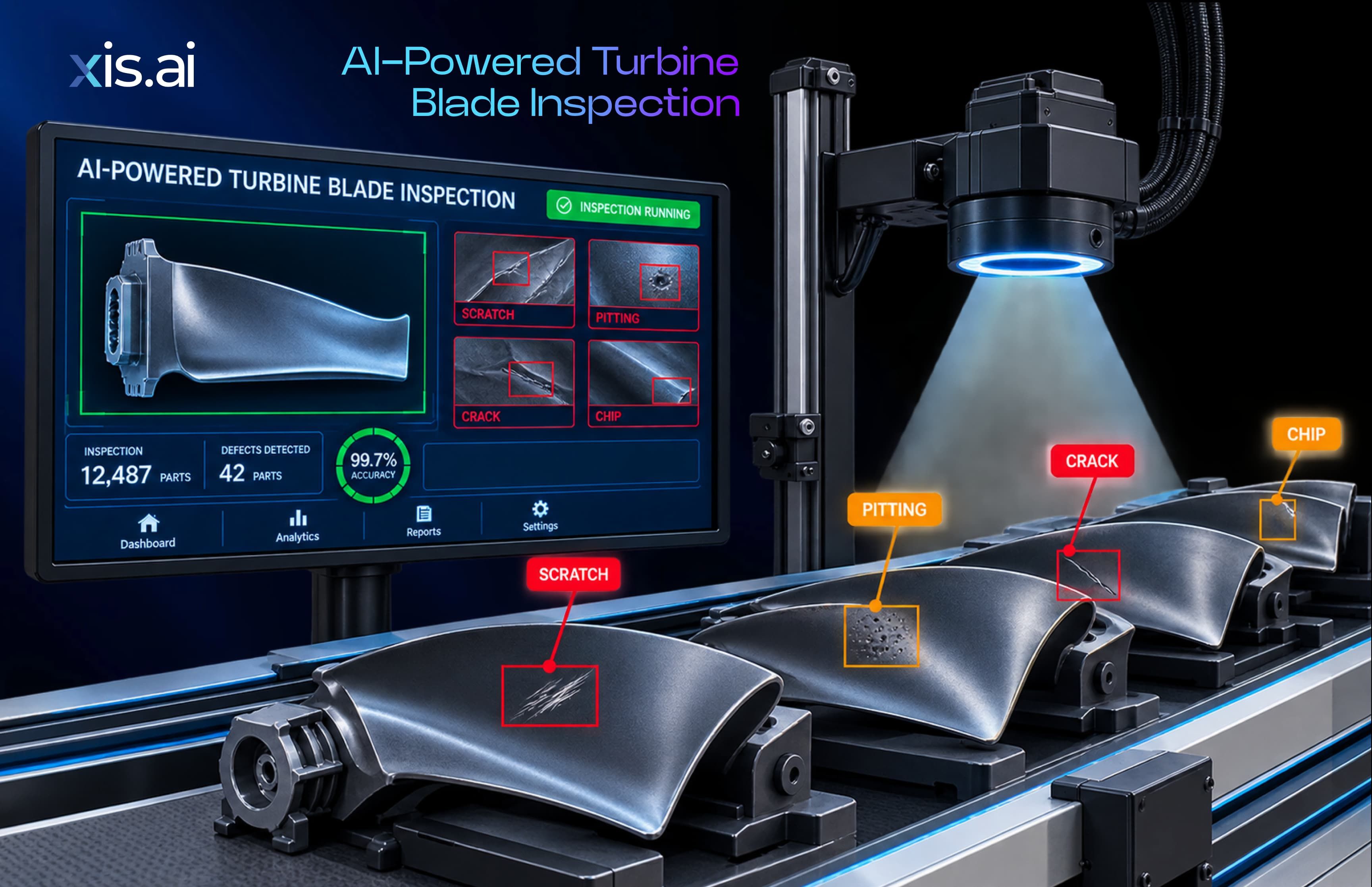
Turbine blade inspection examines turbine blades, in jet engines, auxiliary power units, and industrial gas turbines, for surface cracks, erosion, coating degradation, and dimensional deviation that could compromise performance or structural integrity under extreme operating conditions. A blade operates under mechanical load, thermal cycling, and high-velocity airflow simultaneously, and each defect type traces to a different part of that stress profile: fatigue cracks propagate under cyclic loading, erosion changes the aerodynamic profile through particulate impact, coating defects reduce protection against heat and oxidation, and dimensional deviation affects both aerodynamics and structural balance.
Why the Blade Surface Resists Standard Inspection
A turbine blade's surface is curved along a complex aerodynamic profile and often finished with a polished or reflective thermal barrier coating. This combination defeats assumptions that simpler inspection setups rely on. A defect visible from one angle may be fully obscured from another, particularly on concave or trailing-edge surfaces where lighting falls into shadow. The reflective finish compounds this: glare and specular reflection under standard lighting can either mask a genuine defect or produce a false positive that resembles a crack or coating flaw. Manual inspection under these conditions depends heavily on inspector experience with that specific blade type and lighting setup, difficult to standardize across inspectors, shifts, and blade models, which is why turbine blade inspection has historically leaned on labor-intensive manual review supplemented by dye penetrant testing.
How AI-Based Inspection Closes the Gap
AI-based systems address the geometry problem through multi-angle image capture, covering the blade's full compound curvature rather than a single fixed viewpoint, and through model training specific to the reflective or coated surface of the blade type in production. Because the model learns the visual signature of a defect-free blade, including its expected lighting and reflective behavior, from labeled production data, it distinguishes a genuine crack or coating defect from a lighting artifact more reliably than a fixed-rule system comparing against one static reference image. This is the same principle behind AI-Powered Surface Crack Detection, applied here to one of the more demanding surface types it is asked to handle.
Erosion and coating degradation develop gradually rather than as a discrete event, so inspection benefits from comparing a blade against its own prior inspection record, not only a generic acceptable range. A coating reading slightly thinner than that same blade's last cycle warrants attention even if it would pass a one-time check. AI-based systems retain and compare inspection data across cycles far more consistently than manual review can across many blades, a shift toward inspection as an ongoing diagnostic record rather than a single pass-fail event, discussed further in AI Visual Inspection Guide by Industry: A Complete Overview.
A blade's dimensional profile also connects directly to AI-Powered Precision Component Inspection: a blade eroded or deformed beyond its designed profile is, in effect, a precision component that has drifted out of tolerance, and viewing the two checks together gives a clearer line from a caught defect back to its process cause.
Frequently Asked Questions
Why is turbine blade inspection harder than inspecting a flat metal surface?
Compound curvature and a reflective or coated finish create inspection angles and lighting conditions that can obscure a defect or produce a false positive, problems a flat surface does not present to the same degree.
How does AI handle the reflective surface of a coated blade?
Models are trained on imaging data captured under the same lighting and surface conditions used in production, learning the expected reflective behavior of a defect-free blade so a genuine defect can be distinguished from a lighting artifact.
Can AI detect gradual erosion, not just a discrete defect like a crack?
Yes. Comparing a blade's current inspection data against its own prior history surfaces a gradual trend, such as coating thinning, that is difficult to track reliably through one-time manual review.
Is turbine blade inspection only relevant to aerospace engines?
No. The same principles apply to industrial gas turbines and auxiliary power units, anywhere a blade operates under sustained mechanical load, thermal cycling, and high-velocity airflow.
Comment
0Comments
No comments yet.