AI OCR for Barcode and Label Reading: Making Industrial Data Truly Intelligent

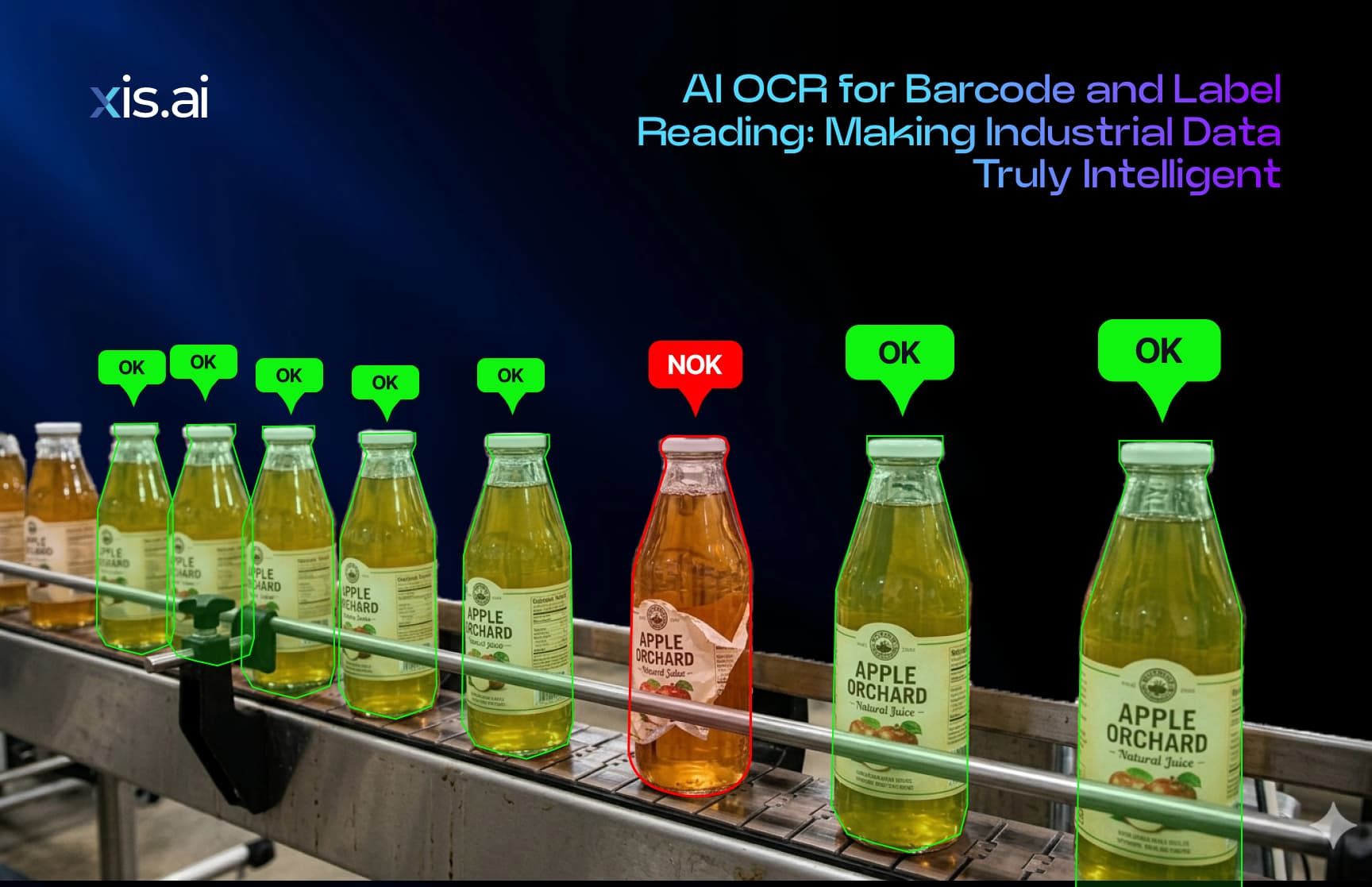
OCR barcode scanning has moved far beyond its original purpose of simply reading barcodes and converting them into digital values. In modern industrial environments, the expectation is no longer just “read correctly,” but “understand correctly.”
This shift is driven by increasing production speed, complex packaging formats, and the growing need for traceability across global supply chains. Labels today often carry multiple data layers—barcodes, QR codes, batch numbers, expiry dates, and regulatory text—all of which must be captured accurately in milliseconds.
Traditional systems struggle in this environment because they depend on ideal conditions. AI-powered solutions, such as those developed by xis.ai, are designed for the opposite reality: imperfect, fast-moving, and high-volume production lines where precision cannot be compromised.
The Real Shift: From Data Capture to Context Intelligence
The most important transformation introduced by AI barcode recognition is not speed—it is understanding.
Conventional systems treat a barcode as an isolated input. If it is readable, it is accepted. If not, it is rejected. AI-based systems work differently. They analyze relationships between multiple data points on the same label and evaluate whether the information is logically consistent.
For instance, a barcode may decode correctly, but if the printed expiry date or batch number does not align with backend production data, the system can immediately flag it. This introduces a new layer of intelligence where scanning is no longer passive—it becomes a validation process embedded in production itself.
This capability is especially critical in regulated industries, where even minor inconsistencies can lead to compliance risks or product recalls.
How Modern OCR Barcode Scanning Systems Actually Operate
A modern OCR barcode scanning system is built as a multi-stage intelligence pipeline rather than a single scanning step.
The process begins with image enhancement, where AI models correct real-world imperfections such as motion blur, uneven lighting, and distorted angles. This is essential because industrial environments are rarely stable, and labels are often captured in motion.
Once the image is stabilized, dual recognition takes place. One AI model decodes the barcode, while another extracts printed text from the same label. Instead of treating these outputs separately, the system aligns and compares them in real time.
What makes this approach powerful is the validation layer that follows. The system checks whether all extracted data follows expected patterns and matches reference rules from production or ERP systems. This is where errors that would normally go unnoticed are caught instantly.
Label Scanning Systems as Embedded Quality Control Infrastructure
A modern label scanning system is no longer an external tool added to production—it is part of the production logic itself.
Instead of relying on post-production inspection, AI systems enable real-time verification as products move along the line. If a label is misprinted, partially missing, or inconsistent with expected data, the system can immediately trigger alerts or stop the process.
This transforms quality control from a reactive process into a proactive one. Errors are not discovered later; they are prevented at the point of occurrence. Over time, this significantly reduces waste, rework, and compliance risks while improving overall production efficiency.
Why AI Barcode Recognition Performs Better in Real Industrial Conditions
The strength of AI barcode recognition lies in its ability to operate in conditions where traditional scanners fail. Manufacturing environments are dynamic—lighting changes, products move rapidly, and surfaces are rarely uniform.
AI models are trained on these variations. They can interpret partially damaged labels, correct perspective distortions, and still extract meaningful data with high confidence. More importantly, they continue to improve through exposure to new label types and production scenarios.
This adaptability makes AI-based systems far more resilient than fixed-rule scanners, especially in industries where packaging designs and materials frequently change.
OCR as a Foundation for Data Integrity in Smart Manufacturing
A significant but often overlooked evolution is that OCR barcode scanning is becoming a data integrity layer rather than just a scanning technology.
Instead of only capturing information, these systems ensure that data is correct, consistent, and traceable across the entire production chain. They validate information against ERP systems, production schedules, and compliance rules in real time.
This is a major step toward smart manufacturing, where machines do not just execute tasks but actively ensure the reliability of the data they generate and process. In this context, OCR becomes a bridge between physical production and digital intelligence systems.
The Role of xis.ai in Next-Generation Label Intelligence
xis.ai is focused on developing advanced label scanning systems that go beyond traditional OCR functionality. The goal is to create systems that not only read labels but understand their meaning within industrial workflows.
By combining deep learning, real-time image processing, and system integration capabilities, xis.ai enables manufacturers to build environments where label data is continuously verified and synchronized with production intelligence systems.
This approach supports higher traceability, fewer production errors, and more reliable automation across complex manufacturing ecosystems.
Conclusion:
The evolution of OCR barcode scanning reflects a broader transformation in industrial automation. What started as a simple identification tool is now becoming a critical intelligence layer in manufacturing systems.
With AI barcode recognition and advanced label scanning systems, industries are moving toward environments where data is not only captured but continuously validated and trusted in real time.
The future of industrial labeling is not about faster scanning—it is about smarter interpretation, stronger validation, and complete data integrity across the entire production lifecycle.
Frequently Asked Questions
What Is OCR Barcode Scanning in Industrial Systems?
OCR barcode scanning is a technology that reads both barcodes and printed text on labels and converts them into structured digital data for industrial use.
How Does AI Improve Barcode Reading Performance?
AI improves performance by handling real-world imperfections such as blur, distortion, and damaged labels while also validating data consistency.
What Makes a Label Scanning System Intelligent?
An intelligent label scanning system not only reads data but also verifies it against business rules and production information in real time.
Can AI Barcode Recognition Work in Fast Production Lines?
Yes, AI barcode recognition systems are designed for high-speed environments and can process multiple labels in real time without losing accuracy.
Why Is OCR Important for Smart Manufacturing?
OCR is essential because it ensures accurate traceability, reduces human error, and enables automated quality control in production systems.
Comment
0Comments
No comments yet.